
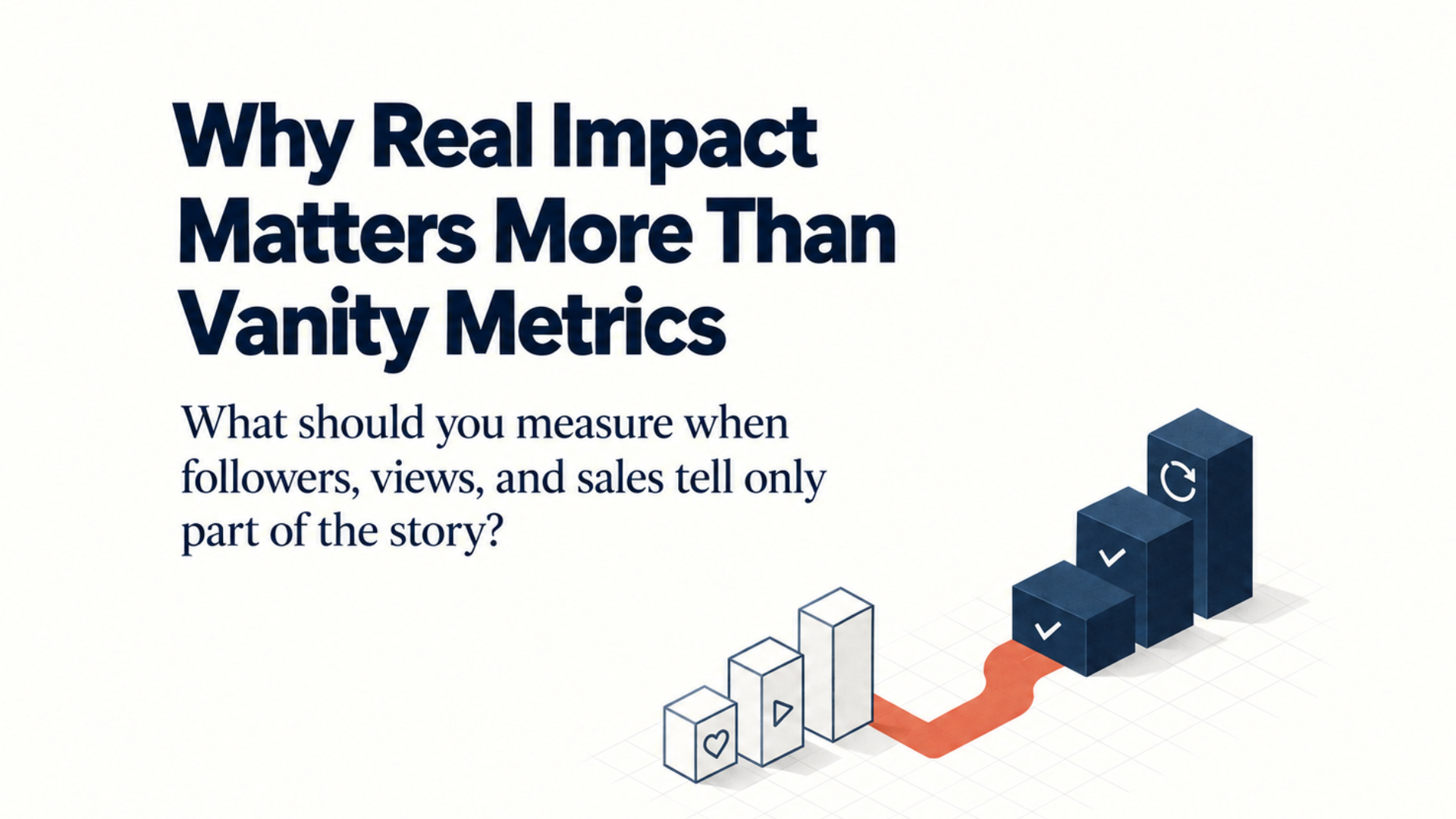
More followers and higher sales can look like progress while hiding weak results. Google’s user-experience research shows why extra activity can mean confusion rather than success. This guide helps you measure what people gain from your work, what it costs to deliver, and whether that value lasts.
Quick Answer
Real impact means your work produces a useful result for the people it is meant to serve. Measure what they accomplish, whether the benefit lasts, and what it costs to deliver. Followers count accounts, impressions count displays, and revenue records sales. Those numbers help you understand performance, but each tells only part of the story.
When a Big Number Becomes a Vanity Metric
A number becomes a vanity metric when you use it to claim progress without checking whether the result you wanted actually happened.
Imagine you sell a workshop on managing business expenses. A funny video brings thousands of people to your page. They enjoy it, leave a few comments, and move on.
Another video gets less attention. It answers a question business owners are struggling with. Several viewers sign up, finish the workshop, and use what they learned to review their expenses.
Both videos did something. The next decision depends on the goal: reaching more people, selling the workshop, or helping customers use the skill.
You need enough evidence to tell which of those happened.
Followers can help you build an audience. Impressions can help you track distribution. Neither tells you, on its own, whether someone paid attention or benefited. Google Ads, for example, counts an impression when an ad is shown.
Why Higher Revenue Can Still Hide a Problem
Revenue shows sales before expenses; profit shows what remains after expenses, and cash flow tracks money moving in and out.
The SEC’s guide to financial statements explains those differences.
A business can increase sales by offering bigger discounts, spending more on ads, or taking jobs that require far more work. The revenue report looks stronger while the owner has less money left and more hours to work.
Ask what changed alongside the sales figure. What did delivery cost? When did customers pay? Did the work solve their problem?
For a creator, there is another question: does earning more require starting from scratch every time, or can customers keep getting value from something you have already made?
Three Questions That Tell You More
Useful measurement starts with what changed, how long the benefit lasted, and what it took to deliver.
What changed? Name something a person could check. A customer completed a job. A reader used your worksheet to make a decision. An employee made fewer mistakes.
Did the benefit last? That could mean a customer used the tool again or bought another product they needed. It could also mean a repair held up. A good repair should not require the customer to keep returning with the same problem.
What did it cost? Include money, staff time, support, upkeep, and work you had to redo. An automated process that saves an hour but needs two hours of checking deserves another look.
Choose answers that fit your purpose. A film made to entertain can be judged partly through audience response and returning viewers. It does not need to produce sales leads to have value.
What Audience Feedback Can—and Cannot—Tell You
Specific feedback helps explain whether people got something useful from your work.
In their 2010 research on measuring user experience, Google researchers described five areas to examine: satisfaction, involvement, adoption, continued use, and success at the task. They also explained that more page views could mean people were getting lost in a confusing interface.
More activity can mean different things.
Email reports have limits too. Mailchimp explains that Apple Mail Privacy Protection can load tracking images before someone opens a message, making recorded open rates unreliable for affected recipients.
A recorded open does not confirm reading. A save does not confirm later use. A compliment does not show whether someone applied the advice.
Ask: “What did this help you do, and what happened afterward?”
The answer gives you something more specific to investigate.
Your Free-Tier Takeaway
Pick one useful result, one action that helps people reach it, and one check on cost or quality.
For a workshop, count people who can use the skill. For a service, check whether the customer’s problem stayed fixed.
Then finish this sentence: “This number helps us decide whether to ______.”
If you struggle to finish it, that number may deserve less space in your report.
For more on connecting attention to business results, read The Death of the Follower Count. To explore earning from work people keep using, read the Publishing Rights Playbook.
The paid section gives you a scorecard, a worked example, and a 30-day plan for putting these questions into practice.
FREE SECTION ENDS HERE
Subscriber pitch: Get the full impact scorecard, simple calculations, a campaign comparison, and a 30-day plan for deciding what to improve.
