
Quick answer
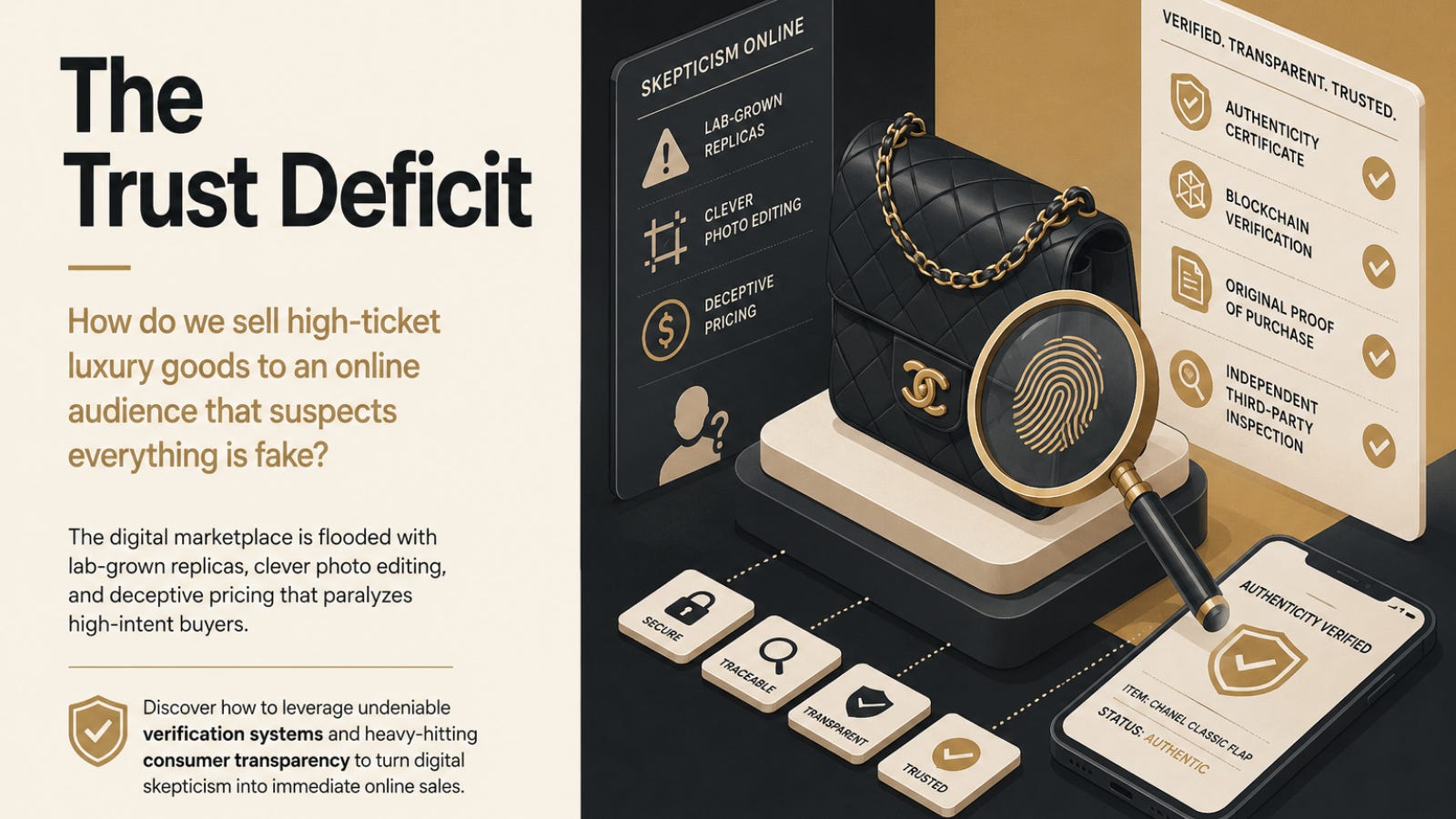
To sell high-ticket luxury goods to an online audience that assumes everything is fake, replace vague “authenticity” promises with a concrete verification stack that is visible at every step of the buying journey. Combine third‑party authentication, traceable documentation, and post‑purchase proof so buyers feel they could defend the purchase in court, not just in the comments.
Why it matters
Counterfeits are now a multi‑billion‑dollar problem, with AI‑assisted fakes eroding consumer confidence and paralyzing legitimate demand. The brands that win the next decade of luxury e‑commerce will treat trust as infrastructure, not copy, turning skepticism into a conversion asset instead of a conversion leak.
In this breakdown
The reality check: Luxury buyers operate in a market where a large share of consumers report having purchased counterfeit luxury goods, often without realizing it.
The utility framework: A five‑layer “Verification Stack” that shows exactly what to validate, how to validate it, and where to surface proof in your UX.
The tactical output: A deployable checklist to redesign product pages, checkout flows, and post‑purchase messaging around verifiable authenticity rather than generic trust signals.
Reality check: Why buyers assume you’re fake
The luxury market is in a documented counterfeit crisis: AI‑enabled factories and resale channels have pushed fake volumes to “critical velocity,” with authentication platforms processing billions of dollars in goods just to keep up. Entrupy, for example, reports authenticating around 3.3–3.7 billion dollars’ worth of merchandise in 2025 alone, across categories like handbags, sneakers, and apparel.
Data from Statista and similar research suggests a sizable share of consumers in the U.S. and Europe have purchased counterfeit luxury items, intentionally or otherwise. U.S. Customs and Border Protection has reported seizing over 1 billion dollars in fake luxury goods annually, and one study found that roughly 28 percent of online counterfeit buyers used AI tools during the process.
Traditional trust tactics—hero brand photography, vague “100% authentic” statements, and generic security badges—fail in this environment because sophisticated fakes now mimic both product and presentation. Marketplaces such as Vinted and eBay have responded by introducing structured authentication flows where higher‑value items are routed through in‑house experts or partners for inspection before they ever reach the buyer, often paired with authenticity labels or certificates.
If your direct‑to‑consumer experience offers less visible protection than a secondhand marketplace, high‑intent shoppers will hesitate, negotiate heavily, or take their money elsewhere. That gap between real‑world counterfeit risk and your visible proof is the trust deficit that kills high‑ticket conversion.
The Verification Stack: Five phases to turn trust into infrastructure
1. Quantify your trust gap
What to do
Measure how often authenticity concerns show up in support tickets, chat logs, reviews, abandoned cart notes, and social DMs.
Why it matters
Without a baseline, you cannot justify investment in better verification, nor can you tell whether any of it is actually moving the needle.
How to do it
Tag historical conversations for terms like “fake,” “authentic,” “counterfeit,” “dupe,” and “scam.”
Run a post‑visit or post‑purchase micro‑survey asking, “What almost stopped you from buying today?” and explicitly list authenticity as an option.
Compare conversion and refund rates on high‑ticket items against mid‑priced SKUs to identify where trust fractures hardest.
Done / not‑done criteria
You have at least 90 days of tagged data and can answer, with a number, “What percentage of lost or delayed revenue ties back to authenticity fears?”
2. Choose your authentication engine
What to do
Match every category in your catalog to a suitable authentication method: AI tools, expert teams, marketplace programs, or a hybrid.
Why it matters
Over‑authenticating cheap items destroys margin; under‑authenticating high‑ticket items destroys your brand.
How to do it
Map your catalog by risk. Louis Vuitton, Gucci, Prada, Chanel, and Dior rank among the most counterfeited or riskiest brands by fake volume and rate, so they warrant the heaviest verification.fashionunited+3
For handbags and accessories, evaluate machine‑learning tools such as Entrupy, which analyzes microscopic images of materials and stitching against tens of millions of reference images and provides an authenticity decision plus certificate.
For sneakers and streetwear, consider dual‑expert services like CheckCheck that combine human authenticators with scalable workflows and enterprise‑grade reporting.
For ultra‑high‑value pieces (watches, fine jewelry), formalize relationships with horologists, gemologists, or brand‑certified experts and standardize their inspection checklists.
Done / not‑done criteria
Every SKU category is mapped to an explicit authentication path with defined tools, costs, and turnaround times.
3. Make authentication visible in your product page UX
What to do
Turn your backstage verification process into front‑stage proof modules on every high‑ticket product detail page (PDP).
Why it matters
Buyers cannot trust what they cannot see; buried FAQ copy is not enough when they are about to wire four or five figures to a stranger on the internet.
How to do it
Add an “Authenticity & Verification” block above or near the fold on every high‑ticket PDP, specifying the methods used (for example, “AI‑assisted microscopic analysis via an independent authentication platform plus secondary expert review on flagged items”).
Note when items over certain thresholds are routed through a dedicated authentication center, mirroring how platforms structure their authenticity guarantees.
Use clean visuals (icons, timelines, or a short three‑step diagram) to show “From listing → inspection → certification → shipping” in one glance.
Anchor metrics to proof, referencing the scale of the data set or inspection volume instead of relying on vague accuracy claims.
Done / not‑done criteria
A new visitor can scan your PDP for five seconds and explain who authenticates the item, how they do it, and what proof the buyer receives.
4. Package proof that survives resale
What to do
Bundle every high‑ticket purchase with portable, buyer‑centric proof—certificates, serial checks, and receipts robust enough for resale, insurance, or disputes.
Why it matters
High‑end buyers are thinking about downside protection and future resale from day one; proof that travels with the item is a conversion lever, not just paperwork.
How to do it
Issue digital and, where appropriate, physical certificates generated by your tools, similar to the certificates produced by AI authenticators.
Include serial numbers, reference codes, and key inspection points on invoices so the receipt is evidence, not just a payment confirmation.
Provide a secure portal or URL where buyers can verify certificates later and share that link with future buyers or insurers.
When selling via marketplaces that add their own verification, explicitly mention that items have passed both your checks and theirs.
Done / not‑done criteria
Every fulfilled high‑ticket order comes with at least one verifiable document beyond a generic invoice, and support can surface or resend it instantly.
5. Turn transparency into a closing script
What to do
Train sales, support, and marketing teams to use your verification stack as a proactive sales tool, not just reactive reassurance.
Why it matters
High‑intent buyers often need a short, precise explanation of why buying from you is safer than buying from a marketplace or an influencer’s link.
How to do it
Write objection‑response scripts that tie specific doubts to specific assets (for example, “For this bag, we run both AI‑based microscopic analysis and a human expert review; you get a certificate and a serial‑logged receipt with your order”).
Fold snippets of your process into ad copy, email flows, and retargeting campaigns so prospects repeatedly see how you protect them.
Use content—short behind‑the‑scenes videos, explainers, or case studies—to show your authentication process in action and connect it to the broader counterfeit crisis.
Done / not‑done criteria
Your top five authenticity objections have scripted responses tied directly to your verification assets, and support can deliver each response in under 60 seconds.
