
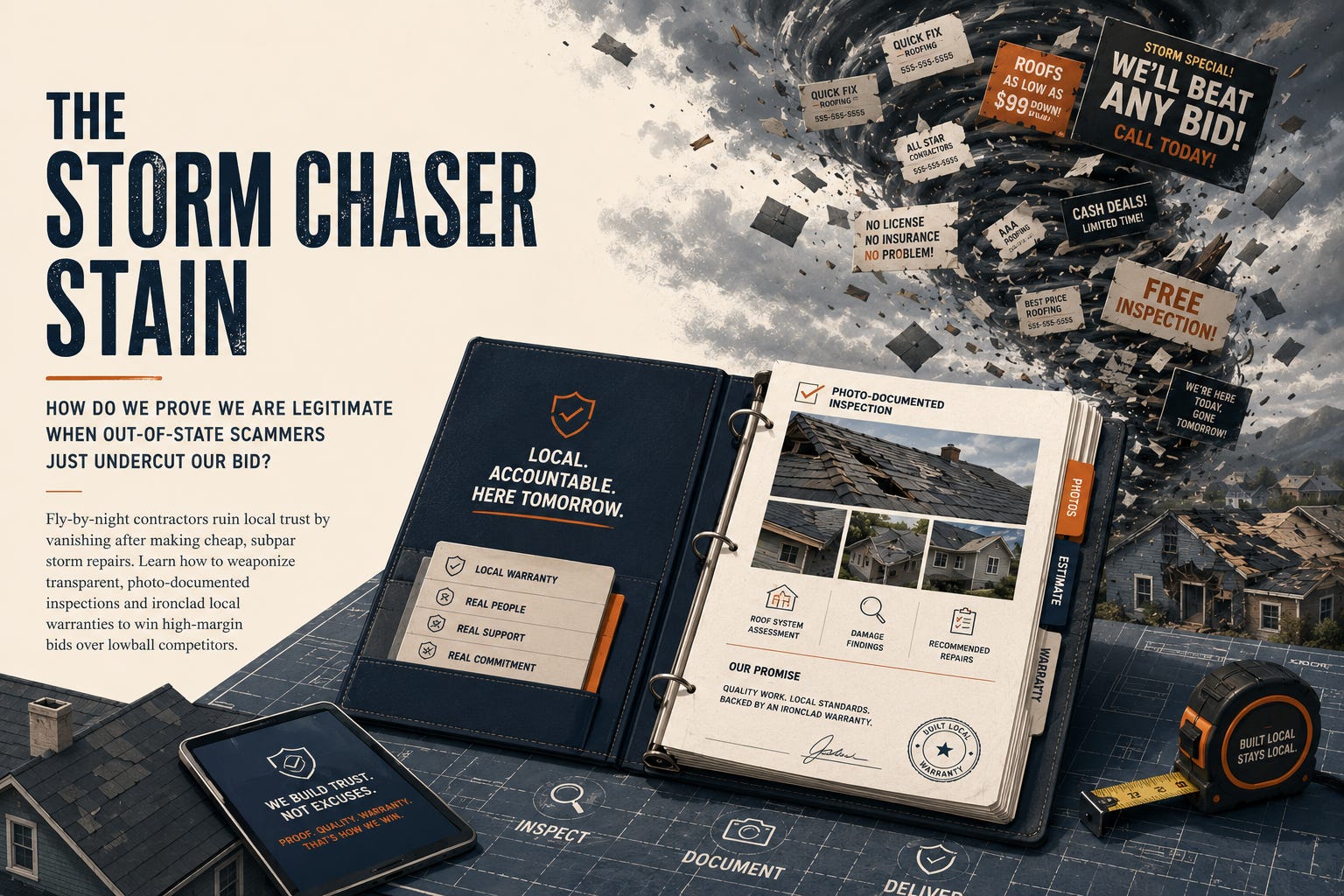
Quick answer
The most reliable way to beat storm chasers isn’t dropping price; it’s reframing the decision around risk. Use structured, photo‑documented inspections, written scopes tied to building code and manufacturer specs, and locally honored warranties, then walk homeowners through the lifetime cost difference between a “cheap fix” and a compliant, warrantied repair.
BBB overview of storm chasers and post‑disaster contractor risks:
BBB storm chaserPrimer on storm chaser roofing scams and reputable contractors:
Storm Chasers & Roofing ScamsgoodvilleHow to photograph shingle roof inspections for insurance and warranty documentation:
RoofPredict inspection guideroofpredict
Why it matters
Storm chasers systematically erode trust in every roofer on the block, leaving homeowners suspicious and insurers skeptical of legitimate claims.
If local contractors don’t actively differentiate their process, they get lumped into the same “roof roulette” bucket—and lose both margin and long‑term customer relationships
Consumer explainer on storm chaser contractors:
Storm Chaser Contractors: What Consumers Should KnowconsumercontractorauthorityRed‑flag list for roofing scams including storm chasers:
Roofing Scams 2026: 12 Red FlagstheroofingbriefNarrative on how storm chasers target homeowners:
Roof Roulette: How Storm Chasers Target Homeownerstrustdale
In this breakdown
The reality check:
Why storm chasers keep winning bids even as they destroy roofs, claims, and reputations.ecowatch+1The utility framework:
A five‑part “Legitimacy Stack” that turns documentation and local presence into a sales weapon instead of overhead.The tactical output:
A homeowner script, inspection checklist, and premium‑tier toolkit you can plug directly into your next hail‑route or insurance meeting.
Supporting context:
NICB / AARP analysis of contractor fraud after storms:
Storm Surges Yield Surges in Contractor FraudnicbConsumer guide to protecting yourself from storm chaser roofing scams:
Protect Yourself Against Storm Chaser Roofing Scamsecowatch
Reality check
Storm chasers are not random bad apples; they are a repeatable business model that shows up any time a map lights up with hail swaths, tornado tracks, or hurricane
They flood the neighborhood with door‑to‑door pitches, promise “free roofs” or deductible waivers, then disappear as soon as the last insurance check clears.
NICB and AARP contractor fraud overview:
NICB contractor fraud blognicb
Explainer on roofing storm chasers tracking hail storms and running door‑to‑door scams:
Local Roofers vs. Storm ChasersvisexteriorBBB warning on storm chasers after various types of storms:
BBB damaging storm tipbbbSigns of storm chaser roof scammers:
Warning Signs of Storm Chaser Roof Scammersdalesroofing
From the homeowner’s perspective, every truck and yard sign looks the same—local logo, out‑of‑state LLC, or temporary P.O. box—and they are under pressure to fix visible damage fast.
Most have no idea what compliant work looks like, what their policy actually covers, or how to verify a contractor beyond a quick online search.
BBB natural disaster resources (including contractor vetting):
Thunderstorm and tornado resourcesbbbYahoo overview of roofing storm chasers targeting “storm‑rattled areas”:
Roofing storm chasers overviewlocal.yahooLocal segment on avoiding contractor scams after storm damage:
How to Avoid Contractor Scams After Storm DamagewfsbStorm chaser contractor explainer:
Storm Chaser Contractors: What Consumers Should Knowconsumercontractorauthority
Historically, the industry’s answer has been more marketing: more yard signs, more “trusted since 1998,” more flyers about “locally owned and operated.”
Under modern stress—rising deductibles, fraud‑sensitive adjusters, viral horror stories, and social media callouts—that vague reassurance does not survive comparison to a storm chaser’s “I’ll handle everything, sign here” pitch.
The net result is a trust recession: homeowners assume everyone is either a scammer or a salesperson, and “who is cheapest” feels like the only rational filter.
That filter is exactly what legitimate contractors must break.
BBB winter‑storm advisory about storm chasers and trust issues:
BBB winter storms resourcebbbConsumer roofing scam guide stressing local, trusted contractors:
EcoWatch storm chaser scam guideecowatchBBB video warning over storm chasers:
BBB issues warning over ‘storm chasers’youtube
The Legitimacy Stack: Five parts
1. Reframe the decision around risk, not price
What to do:
Rewrite your pitch so the homeowner is choosing between levels of risk instead of line‑item prices: uninsured labor vs. insured; code‑compliant install vs. patch; temporary repair vs. warrantied replacement.
Why it matters:
Storm chasers win when the conversation stays at “how cheap” and “how fast.”
They lose when homeowners understand insurance fraud exposure, denied future claims, manufacturer warranty voids, and the actual cost of re‑doing failed work.
Chicago Home Inspector overview of storm chaser roofing scams and deductible fraud:
Storm Chaser Roofing Scams: What to Know Before Signingchicagohomeinspector
“7 Reasons Not to Use Storm Chasing Roofers” (risk framing, warranty, long‑term cost):
Reasons Not to Use Storm Chasing Roofersjrcousa
How to do it (steps):
Start with the policy and the law, not the shingle color.
Explain, in plain English, what their deductible covers, what insurance will not cover, and why waiving or rebating a deductible is classified as fraud in many states.
Use a simple table in your leave‑behind showing “cheap fix” vs. “code‑compliant repair” over 10–15 years: total out‑of‑pocket, warranty coverage, leak likelihood, resale impact, and insurance relationship impact.
Replace generic reassurance (“we’re local”) with specific risk counters: license number, insurance verification, code references, and written warranty terms they can verify without you present.
Real‑world example:
A Midwest contractor confronted a storm chaser’s lowball proposal by walking the homeowner through a one‑page comparison: the chaser’s bid included waiving the deductible and re‑using compromised decking, which they flagged as insurance fraud and a warranty violation with supporting references.
The homeowner chose the compliant bid at a higher price because the risk differential was explicit.
Done / not‑done criteria:
Done: Your proposal explicitly calls out risk categories (legal, warranty, leak, resale) and ties them to documented evidence.
Not done: Your proposal still competes mostly on “better materials” and “excellent customer service.”
2. Turn inspections into visible evidence, not opinion
What to do:
Standardize a photo‑documented inspection protocol that produces a visual dossier of the roof and exterior, mapped to specific codes, manufacturer guidelines, and policy language.
Why it matters:
Homeowners cannot see their roof and cannot evaluate whether a missing shingle is cosmetic or systemic.
Storm chasers exploit this asymmetry by inventing damage, exaggerating scope, or hiding shortcuts where the homeowner will never climb.
BBB guidance on documentation and cautious inspection:
BBB storm chaser tipbbbRoofPredict’s practical guide to documenting shingle roofs for warranty and insurance:
How to Photograph a Shingle Roof Inspection for WarrantyroofpredictBBB’s post‑storm contract and documentation checklist:
BBB Tip: After a Damaging StormbbbRed‑flag list including fake damage and invisible shortcuts:
Roofing Scams 2026: 12 Red Flagstheroofingbrief
How to do it (steps):
Use a structured shot list: wide‑angle elevations, slope‑by‑slope photos, close‑ups of shingles, flashing, penetrations, gutters, decking, and attic signs of water.roofpredict
For each defect, pair the photo with a plain‑English label and a reference to either local building code or manufacturer installation guides.
Deliver the inspection as a simple PDF or cloud folder sorted by area (front, back, left, right) so the homeowner can scroll damage like a gallery.roofpredict
Include “baseline” photos where no damage is present, proving you are not just cherry‑picking bad shots and helping future claims by documenting pre‑storm condition.
Real‑world example:
A regional roofer in the Southeast began treating every inspection like an adjuster’s file: 50–80 annotated photos per job.
Once homeowners could see rotten decking and compromised flashing instead of hearing abstract descriptions, full‑replacement close rates rose against “quick patch” competitors.ecowatch+1
Done / not‑done criteria:
Done: Every bid comes with a photo bundle and a one‑page summary homeowners can show to an adjuster, spouse, or buyer.
Not done: You still rely on pointing at the roof from the ground and saying “it’s bad.”
3. Make your local footprint tangible and verifiable
What to do:
Package proof of local presence—permits, office address, licensing records, supplier references, and real customer reviews—into a single “local legitimacy” dossier.bbb+1
Why it matters:
“Locally owned and operated” has become a meaningless slogan.
Storm chasers routinely set up temporary LLCs, rent short‑term office space, or use P.O. boxes to appear local while planning to vanish after the season.dalesroofing+1
BBB advice on researching contractors, licenses, and complaint history:
BBB Tip: After a Damaging StormbbbStorm chaser vs. local roofer comparison:
Avoid Roofing Scams: Local Roofers vs. Storm ChasersvisexteriorConsumer Contractor Authority overview of storm chaser structures:
Storm Chaser Contractors: What Consumers Should KnowconsumercontractorauthorityRoofing scam guide emphasizing physical locations and identification:
Warning Signs of Storm Chaser Roof Scammersdalesroofing
How to do it (steps):
Create a one‑pager listing your physical address, years in business, local license numbers, and direct links to city or state contractor registries.bbb+1
Add screenshots or printouts of your BBB profile and review platforms, focusing on local job histories.
Include a short list of local suppliers and adjusters willing to confirm you’re a long‑term in‑market contractor.
Offer a “local continuity” guarantee: service crews based within X miles, response times measured in days, not months.
Real‑world example:
An Ohio roofing company brought a “Local Proof” binder to every kitchen‑table meeting: business license, municipal registration, office photos, warehouse shots, and a printed map from the homeowner’s address to their shop.
Prospects stopped asking “are you storm chasers?” and started asking detailed, project‑specific questions.
Done / not‑done criteria:
Done: A stranger in your city could verify your existence and licensing without calling you.
Not done: Your “local” proof is just a tagline and a phone number.
4. Engineer your warranty as a selling weapon, not fine print
What to do:
Design a clear, written warranty that spells out term length, coverage, claim handling, and manufacturer warranty overlap—then present it early in the sales conversation.
Why it matters:
Storm chasers often promise “lifetime warranties” verbally, then vanish or stop answering the phone once issues emerge.
Homeowners who have lived through that once become skeptical of any warranty language, even the legitimate ones.
Storm chaser scam article explaining bogus warranties:
Storm Chasers & Roofing ScamsgoodvilleLong‑term case against storm chasers and for reliable warranty‑backed roofers:
7 Reasons Not to Use Storm Chasing RoofersjrcousaConsumer guide on storm chaser contractors and “disappearing acts”:
Storm Chaser Contractors: What Consumers Should Knowconsumercontractorauthority
How to do it (steps):
Put your workmanship warranty on a single, readable page with bullet‑point coverage: leaks, workmanship, wind speeds, and transferability.
Tie warranty conditions visibly to your inspection and installation process.
Clarify the difference between your workmanship warranty and the manufacturer’s product warranty, including your role in material defect claims.
Include anonymized case snapshots where you honored the warranty quickly after wind or hail events.
Real‑world example:
A Pacific Northwest roofer began leading with warranty during sales appointments, showing timestamps of previous service calls and repairs after big windstorms and how they honored both workmanship and manufacturer coverage.
Homeowners treated the higher bid as protection against another fight with a disappearing contractor.
Done / not‑done criteria:
Done: Warranty is written, specific, and integrated into your risk framing.
Not done: Warranty sits as small print at the back of your contract.
5. Script the homeowner conversation around verification, not persuasion
What to do:
Train your team to use a standardized script that shows prospects how to check credentials, compare bids, and spot red flags—positioning you as a guide rather than a closer.
Why it matters:
Consumer protection organizations and insurers stress the same actions: call your insurance company, research contractors, verify licensing, get everything in writing, and resist high‑pressure sales.
If your script echoes those trusted voices, you borrow their authority and stand apart from canvassers pushing a fast signature.
WFSB’s segment on avoiding contractor scams after storms:
How to Avoid Contractor Scams After Storm DamagewfsbBBB storm chaser guidance with verification steps:
BBB storm chaser guidebbbBBB post‑storm contract and verification checklist:
BBB Tip: After a Damaging StormbbbFOX17 segment warning about storm chasers and advising verification:
BBB warns homeowners about storm chasers after icy weatheryoutube
How to do it (steps):
Open by asking whether they’ve spoken to their insurer; if not, encourage that and offer to document damage for the claim.
Use a simple checklist: “Here are five questions to ask any roofer, including us”—license, insurance, local references, warranty terms, deposit requirements.
Teach red flags: big cash deposits, pressure to sign today, deductible‑cover offers, and contractors asking to be paid directly with the insurance check.nicb+1
Close by positioning your company as the benchmark: “Use this checklist with our bid and anyone else’s; we want you confident, even if we’re not your choice.”
Real‑world example:
One contractor embedded BBB’s storm chaser checklist into their handouts, explicitly telling homeowners to apply those tips to every bid they received.
Far from scaring people off, it increased trust and made out‑of‑town canvassers look sloppy by comparison.
Done / not‑done criteria:
Done: Your team can deliver a calm, educational script that invites verification and comparison.
Not done: Your pitch is still mostly about “signing before the other guys show up.”
Common mistakes homeowners make with storm repairs
Signing over insurance checks or benefits to contractors instead of paying by card or check after work is completed.
Accepting large cash‑upfront demands or full pre‑payment before materials arrive on site.
Letting door‑to‑door solicitors inspect roofs unaccompanied, creating or exaggerating damage for profit.bbb+1
Failing to verify licenses, insurance, complaint history, and physical addresses through official registries and local agencies.
Tools and infrastructure to standardize
A shot‑list‑based inspection app or template with required photo angles and annotation fields.
A “local proof” dossier with licenses, insurance certificates, registry links, and BBB profile screenshots.
A one‑page, plain‑English warranty sheet with QR codes to manufacturer documentation.
A laminated homeowner checklist card echoing BBB and NICB guidance.
Paywall break (premium tier)
If you’re ready to move from strategy to execution, this is where we shift into the full operating system—scripts, configuration details, and implementation assets you can deploy directly in your next storm route.
