
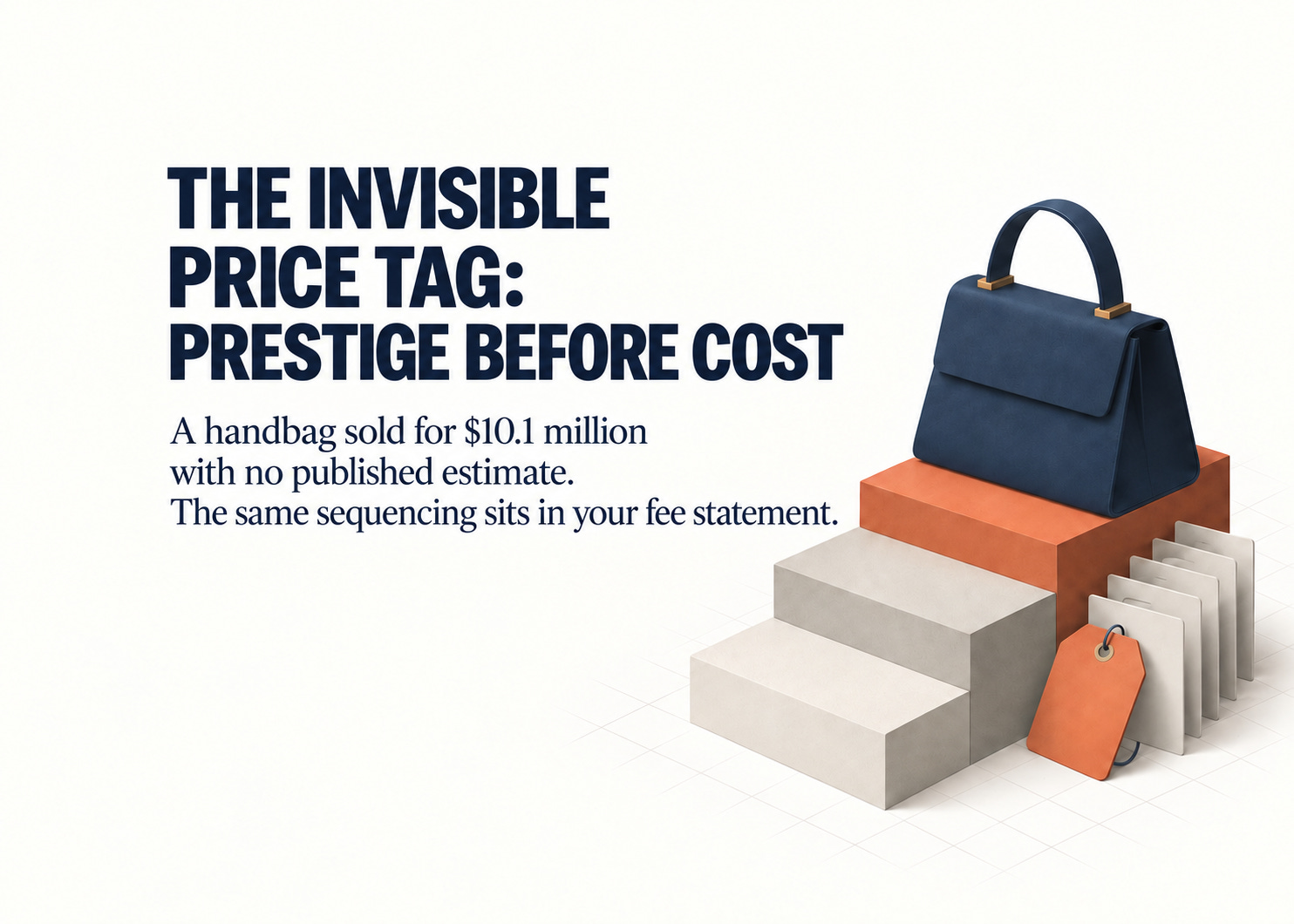
Elite brands delay the price to protect desire from sticker shock. The same decoupling sits in your fee statement, and the SEC has already put a number on it.
Quick answer
An invisible price tag is a sequencing choice: the seller lets desire form fully before the number arrives, instead of presenting both at once. Nothing is concealed. The price is disclosed, usually in writing. What changes is the order it arrives in, and order changes what people pay.
The clearest documented case is the original Hermès Birkin, sold at Sotheby’s Paris in July 2025 with no published estimate. Bidding opened at 1 million euros, which by itself exceeded the previous world record for any handbag. It closed at 8.582 million euros, 10.1 million dollars.
The same sequencing runs on ordinary investors through percentage-denominated fees. On the SEC’s own illustration, a 1 percent annual fee instead of 0.25 percent costs 29,200 dollars over twenty years on 100,000 dollars, which is 26.9 percent of everything the portfolio earned.
What the research actually calls this
The academic term is the coupling and decoupling of payment and consumption, from Prelec and Loewenstein’s 1998 paper in Marketing Science.
Their argument is that a purchase carries an immediate pain of paying that runs against the pleasure of consumption. Their own example is the ticking taxi meter. From a purely hedonic standpoint, the ideal arrangement is one where payment evokes the benefit it financed while consumption does not evoke the payment. Against that sits what they call decision efficiency: consumers need to know what they are paying, or they cannot choose well. The paper is explicit that the two objectives conflict, and that anyone designing a price structure should be aware of both.
Note the asymmetry. The tension is real and the paper names it. But a seller optimising only the first objective has no reason to fix the second.
Why sequence changes the number
Knutson and colleagues put the sequence itself into an experiment.
In a 2007 study in Neuron, twenty-six subjects were given 20 dollars and scanned while shopping. They saw a product, then saw its price, then decided. Preference for the product tracked activity in the nucleus accumbens. Prices the subjects judged excessive tracked activity in the insula, alongside reduced activity in mesial prefrontal cortex. Each signal predicted the subsequent purchase independently of what subjects said about themselves.
Two honest limits before anyone builds a theory on this. The sample was twenty-six people. And inferring a specific felt experience backwards from one brain region lighting up is a contested move in neuroimaging generally. Read the finding as product and price recruiting separable systems in a fixed order, not as scientists locating the sticker-shock centre.
The behavioural evidence is blunter. Prelec and Simester ran auctions involving genuine transactions of potentially high value, for real Boston Celtics and Red Sox tickets, and found that willingness to pay rose when bidders were told they would pay by credit card rather than cash. The authors put the upper bound of the effect at 100 percent, and argued it was unlikely to be explained by liquidity constraints alone. Same object, same buyer, different position of the payment in the sequence.
The purest example: a $10.1 million handbag
In July 2025 Sotheby’s Paris sold the original Birkin prototype with no published estimate.
The lot was catalogued as estimate upon request. One trade report adds that Sotheby’s declined even the discreet range that normally goes to the press for such lots, and that the bag carried a third-party irrevocable bid, meaning it was already guaranteed to sell at a floor nobody in the room knew.
Bidding opened at 1 million euros. That figure alone exceeded the previous world record for any handbag at auction, the 513,040 dollars paid in 2021 for a Himalaya Kelly 28. Nine bidders competed over roughly ten minutes by telephone, online and in the salesroom. The hammer fell at 7 million euros. With premium, 8.582 million euros, or 10.1 million dollars. Tokyo-based reseller Valuence Japan later said it was the buyer.
Strip the romance out and look at what the sale structure did. No number was published. Every bidder had to reach their own valuation from provenance alone, then discover the market’s number in real time against nine other people. The first figure anyone heard, 1 million euros, was already a record, which reset the frame for everything after it.
Then there is the second invisible price tag, the one nobody in the room announced. The hammer was 7 million euros and the buyer paid 8.582 million. The premium added 1.582 million euros, about 22.6 percent on top of the number the room actually heard. That gap is not a psychological trick. It is a published line item. But it is a line item that arrives after the decision, which is the whole pattern in miniature.
Related reading
[LINK 1 — your portfolio allocation post, descriptive anchor text]
[LINK 2]
[LINK 3]
The bridge
Everything above establishes the mechanism and shows it working where the stakes are theatrical. Everything below shows it working where the stakes are yours, and puts a recomputed number on it.
Below the paywall: the full fee model with the arithmetic shown, the four inputs that change the answer, the conditions under which the conclusion fails, and the four places this sequencing is already running on you.
