
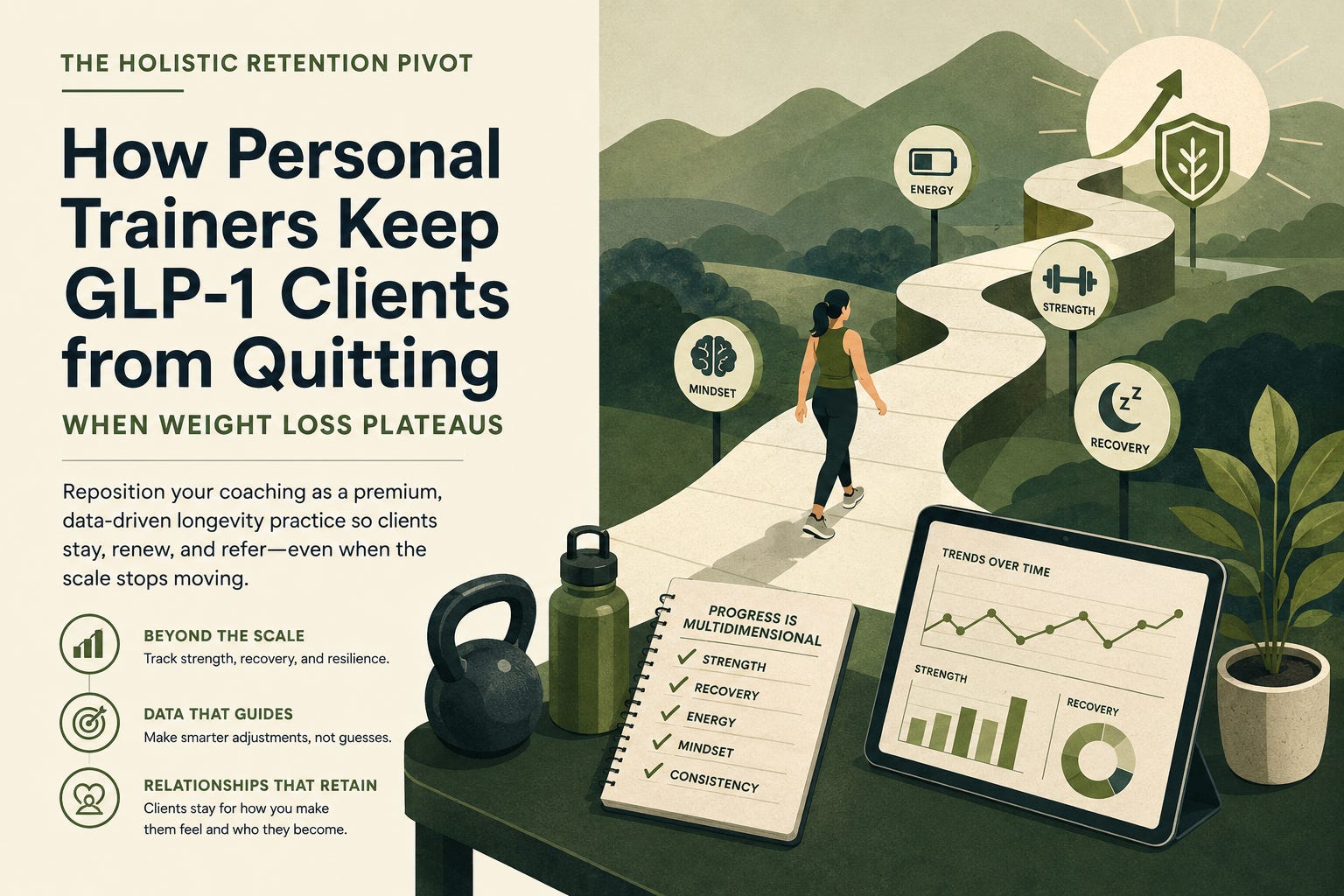
In an era dominated by GLP‑1 weight‑loss drugs and rapid aesthetics, most trainers still sell results in weeks while biology is playing out over years.
Clients hit plateaus, panic, and cancel—not because coaching stopped working, but because success is defined too narrowly as “downward scale movement” instead of stronger, more resilient, better‑recovered bodies.
This article gives you a retention‑first operating system: how to reposition your coaching as a premium, data‑driven longevity practice so GLP‑1 clients stay, renew, and refer even when weight loss slows.
Quick answer
Personal trainers keep GLP‑1 clients from quitting by changing the core promise of coaching from “fast weight loss” to “long‑term strength, sleep, recovery, and muscle retention,” then proving that progress with visible data every month.
When clients understand that plateaus are biologically normal and see improvements in strength, muscle, sleep, and energy on a dashboard, they stop treating a stalled scale as failure and start treating it as part of a long‑term plan.
Why it matters
Nearly everyone on GLP‑1s hits at least one plateau, often between four and six months, and many will hit more as their body adapts.
Clinical and coaching guidance—like Supporting Clients Through Their GLP‑1 Medication Journey and GLP‑1 Weight Loss Plateau: Why It Happens and How to Break It—shows these stalls are expected, not mysterious failures.
At the same time, client churn—not lack of leads—is the single biggest threat to a personal training business, as retention guides such as Personal Trainer Client Retention: The Systems That Actually Work and How to Retain Personal Training Clients in 2026: 10+ Tips make clear.
If your product is “visible weight loss,” plateaus are existentially dangerous; if your product is “weight‑bearing longevity,” plateaus are expected and coachable.
In this breakdown
The reality check: Why GLP‑1 plateaus trigger cancellations and how traditional PT framing makes it worse.
The utility framework: A five‑step Holistic Retention Pivot that turns GLP‑1 coaching into a longevity subscription.
The tactical output: Scripts, metrics, and session structures you can deploy this week to make clients stay for years.
Reality check: the GLP‑1 plateau and trainer churn
GLP‑1 medications like semaglutide and tirzepatide often produce rapid weight loss in the first four to six months, followed by slower, steadier drops or plateaus as metabolic adaptation sets in.
For a clinical overview of why these stalls happen, see GLP‑1 Weight Loss Plateau: Why It Happens and How to Break It.
Plateaus lasting two to eight weeks are usually a normal part of the process, driven by changes in energy needs, fluid shifts, digestion, protein intake, and constipation—not necessarily because the drug “stopped working.”
GLP‑1 Plateau: Causes & Solutions summarizes these factors and first‑line fixes clearly
Yet personal training clients rarely think in terms of metabolic adaptation or body recomposition; they think in terms of “pounds per week.”
When the rate slows, they often assume something is broken—either the medication, the training, or both—even if they are losing inches, gaining strength, and feeling better.
Industry retention guides—such as Personal Trainer Client Retention: 10 Proven Strategies, Personal Trainer Client Retention: The Systems That Actually Work, and How to Retain Personal Training Clients in 2026: 10+ Tips—consistently show that clients leave when value feels invisible, progress is undocumented, communication drops, or the service no longer fits their life, not purely because of price.
GLP‑1 clients are particularly vulnerable because their expectations have been primed by before/after marketing and “8‑week transformation” stories, not by decade‑long health‑span narratives highlighted in resources like Supporting Clients Through Their GLP‑1 Medication Journey.
The old model—selling sessions and “tone up” packages—breaks under this stress because it treats the coach as a short‑term fat‑loss vendor instead of a long‑term health partner.
To keep GLP‑1 clients, you have to rebuild the product around longevity metrics and retention systems, not just aesthetic milestones.
If you’re ready to move from strategy to execution, this is where we shift into the full operating system—templates, configuration details, and implementation scripts you can deploy directly.
