
Quick answer
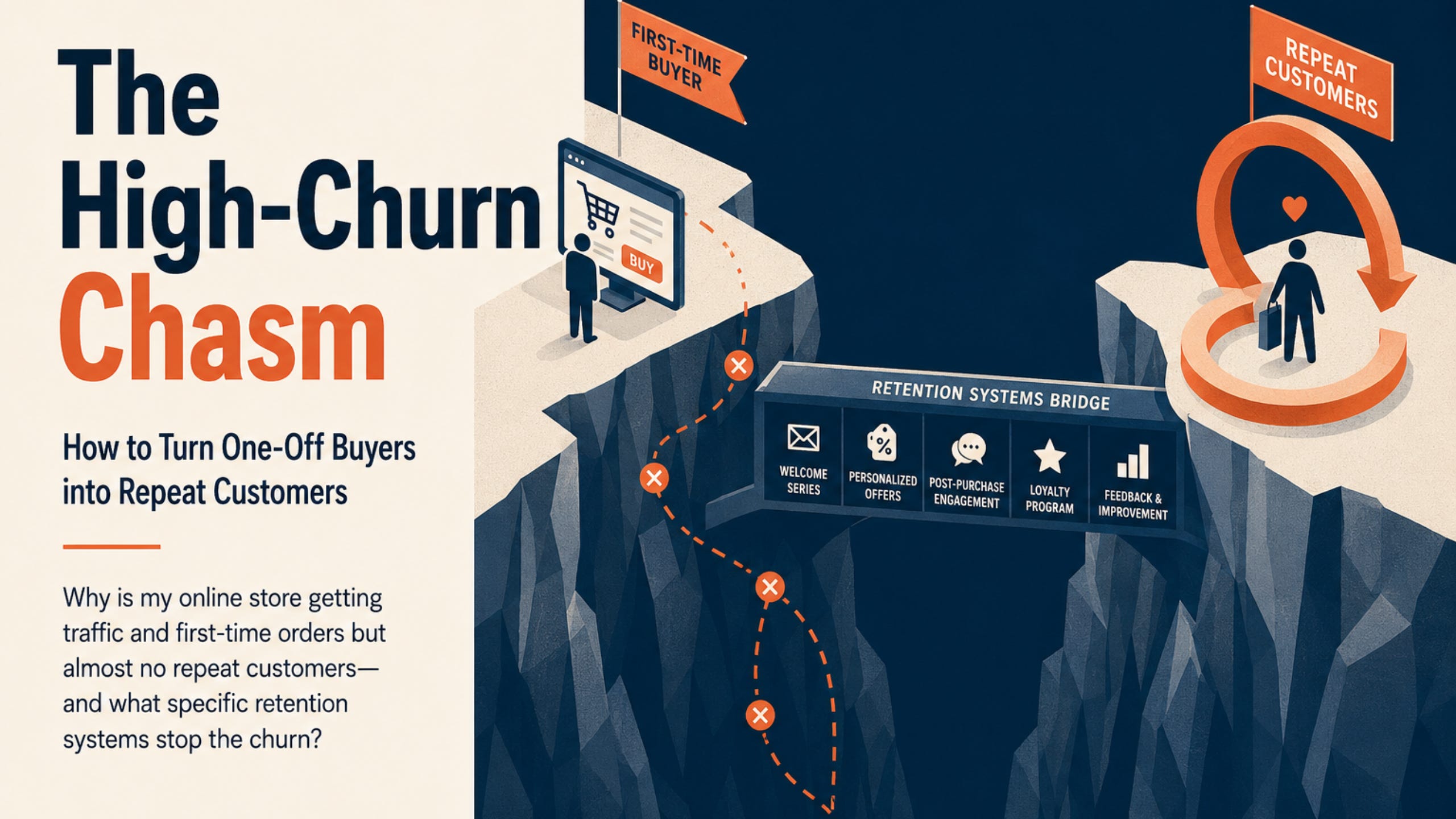
Most online stores struggle with repeat customers because they treat every purchase as a finished transaction instead of the first step in a mapped relationship. Fixing this requires a deliberate retention spine: post‑purchase email flows, simple loyalty incentives, frictionless returns, and on-site experiences designed to bring buyers back within 30–90 days.
Why it matters
Without retention, customer acquisition costs climb while margins shrink, forcing stores to over-spend on ads just to stand still. Installing a basic retention system turns each initial purchase into a recurring revenue stream, compounding lifetime value and stabilizing growth.
In this breakdown
The reality check: Most ecommerce operators over‑invest in traffic and under‑invest in the systems that turn new buyers into loyal customers.
The utility framework: A three‑phase retention spine that mirrors the warmth of a local shop: welcome and onboarding, first‑30‑day engagement, and 90‑day loyalty loops.
The tactical output: Concrete email sequences, on-site prompts, and measurement dashboards you can copy to cut churn and lift repeat purchase rates.
Reality check: why your traffic doesn’t turn into customers
For most ecommerce brands today, acquisition is easy to measure and hard to resist—traffic graphs look healthy, ad dashboards show clicks, and first purchases arrive steadily. What quietly kills the business is the invisible cliff after that first order: a large share of buyers never return within six months, forcing constant ad spend just to replace them.
Industry norms still assume that once someone buys, they’ll come back “if the product is good,” leaving retention to vague hopes or ad retargeting. Under modern conditions—rising acquisition costs and crowded product categories—this legacy approach fractures; operators need structured lifecycle marketing, proactive service, and loyalty infrastructure or churn will keep erasing growth.
Step 1: Map your retention spine
What to do
Design a simple three‑phase customer journey: welcome and onboarding, first‑30‑day engagement, and a 90‑day loyalty loop, with specific touchpoints in email, on-site prompts, and support.
Why it matters
Retention works best when it’s systematic; stores that implement structured lifecycle sequences see higher repeat purchase rates, CLV, and lower churn than those relying on ad hoc campaigns.
How to do it
In your ESP (Klaviyo, Omnisend, Mailchimp), create three flows triggered by first purchase, 7 days after delivery, and 60–75 days of inactivity.
On your site (Shopify, WooCommerce), add post‑purchase and account dashboard prompts for reorders, cross‑sells, and loyalty enrollment.
Document this spine in a simple diagram or checklist so every campaign maps to a phase instead of random blasting.
Real-world example
Subscription merchants with clear onboarding and renewal journeys retain a significantly higher share of subscribers than one-off ecommerce buyers, highlighting the value of structured repeat interactions.
Done / not-done criteria
You have a written map showing touchpoints by time window and channel; every new campaign is tagged to a phase of the spine, not launched in isolation.
Step 2: Fix the first 30 days
What to do
Treat the first 30 days after a customer’s purchase as your retention crucible: send a welcome sequence, post‑purchase education, review request, and a low-friction second-offer tailored to their initial order.
Why it matters
Many retention experts argue the first month is where loyalty is won or lost; experiences that feel generic, confusing, or silent push customers to forget the brand and never return.
How to do it
Welcome email (within 24 hours): Thank them, restate product value, explain what happens next, and invite them to set preferences or join your list.
Post‑purchase support email (5–7 days after delivery): Verify the order arrived, share usage tips or FAQs, and provide an easy path to help if something went wrong.
Review / feedback request (10–14 days): Ask for a rating, offer small loyalty points or a perk, and display reviews prominently on-site to build trust.
Second-offer email (around day 20–30): Recommend a complementary product or refill, ideally with subtle incentive or bundle pricing rather than deep discounting.
Real-world example
Operators on ecommerce forums often report their biggest retention gains from straightforward email automation tied to post‑purchase behavior—welcome, follow‑up, and reactivation—rather than complex CDPs.
Done / not-done criteria
Every first‑time buyer receives at least three distinct, value-adding emails in the first month: welcome, support, and feedback/second offer, with open and click metrics tracked.
Step 3: Build a loyalty loop that feels like your local shop
What to do
Implement a lightweight loyalty program and frictionless returns so repeat purchases feel naturally rewarded and problems are easy to resolve.
Why it matters
Loyalty programs and easy returns encourage customers to stay with one storefront instead of “shop-hopping,” directly improving repeat purchase rates and word-of-mouth referrals.
How to do it
Launch a free points-based loyalty program or punch‑card style scheme with meaningful rewards—discount tiers, early access, or bonuses for repeat orders.
Make returns and exchanges simple and clearly explained on your site, potentially offering free shipping on exchanges to keep buyers engaged.
Add anniversary or milestone emails (for example, a 1‑year customer “birthday”) that celebrate the relationship and offer a small surprise or thank‑you.
Use personalization—recommendations based on past orders—to make every interaction feel tailored, as modern shoppers increasingly expect individualized experiences.
Real-world example
Coffee shops and local retailers use punch cards and staff recognition (“the usual?”) to keep customers returning; ecommerce stores replicate this via digital loyalty programs, tailored recommendations, and personal check-ins.
Done / not-done criteria
Customers can easily find your loyalty and returns info, enrollment happens automatically at checkout or via email, and you can see at least one lifecycle touchpoint beyond the first month for each buyer.
Step 4: Measure what actually keeps customers
What to do
Track repeat purchase rate, churn rate, and customer lifetime value (CLV) as your primary retention KPIs, and tie them to specific campaigns.drip+2
Why it matters
Without measurement, it’s impossible to know whether retention efforts are working or which parts of the spine need attention; these metrics directly correlate with profitability and growth.
How to do it
Calculate repeat purchase rate as the percentage of customers who buy more than once within a fixed period.
Monitor churn by tracking how many customers go inactive beyond 90 or 180 days without a purchase.
Estimate CLV using average order value and average number of purchases per customer, and watch how CLV changes after you launch new flows or loyalty elements.
Real-world example
Retention guides from platforms like Drip and Shopify emphasize repeat purchase and CLV as core metrics, noting that repeat customers tend to buy more, spend more, and refer more than new buyers.
Done / not-done criteria
You have a simple dashboard or sheet that reports repeat purchase rate, churn, and CLV monthly, and you review it when planning campaigns.
Common mistakes to avoid
Treating retention as “discounts only” instead of experience, service, and relationship-building.
Making returns confusing or painful, which destroys trust and makes customers churn permanently.
Sending the same generic email to everyone instead of using behavior-triggered flows.
Final word
Consistent growth in ecommerce doesn’t come from louder ads; it comes from quietly turning every first-time buyer into someone who genuinely expects to come back.
Subscribe to the premium tier to access the complete operational toolkit: copy‑and‑paste email flows, loyalty program configuration options by margin profile, and a minimal KPI dashboard you can drop into your analytics stack.
