
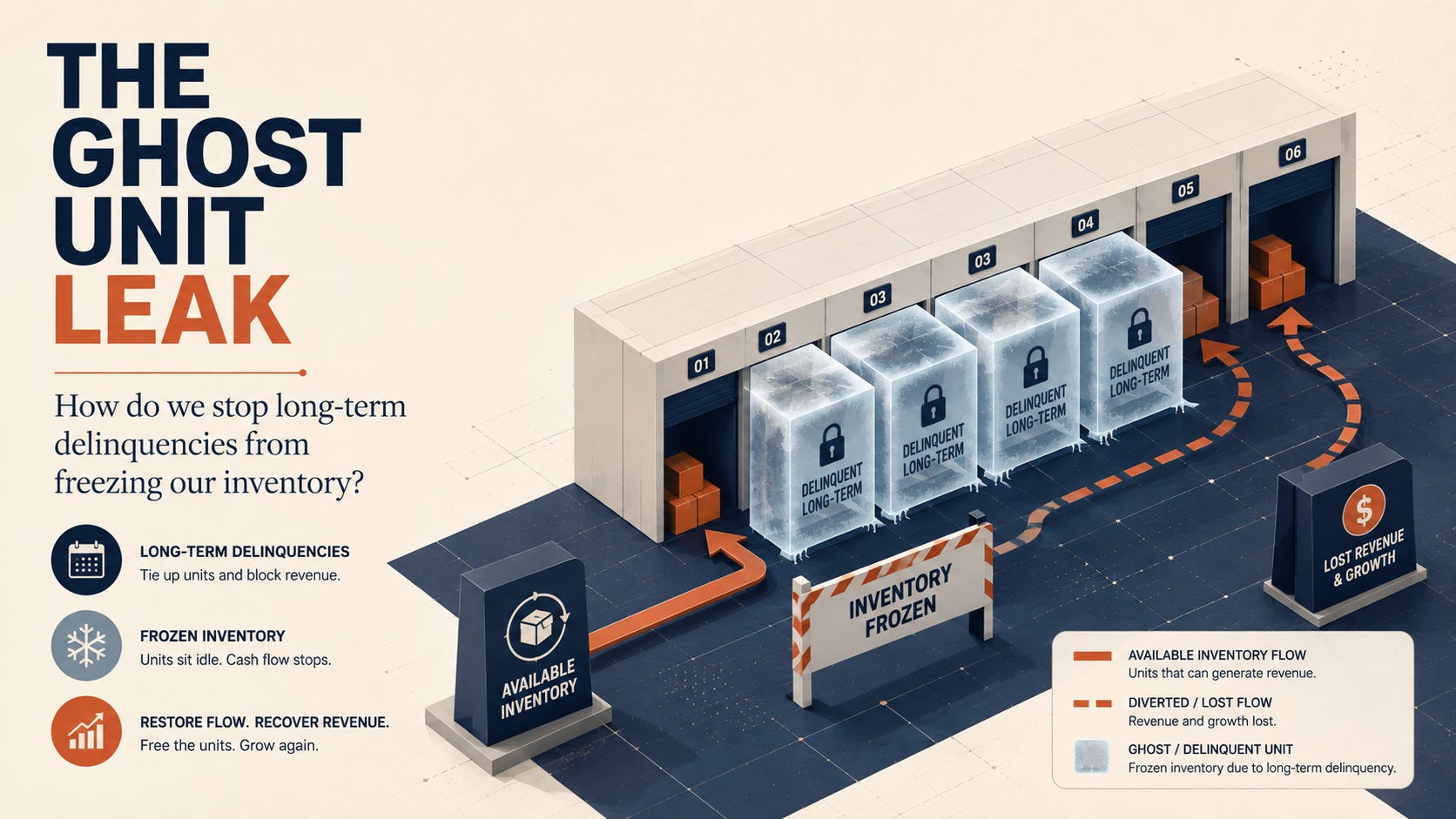
Quick Answer
Stop ghost units by making payment frictionless, automating collections deadlines, and moving unresolved accounts through a documented, state-compliant lien process.
Track the time from missed payment to re-rent—not just occupancy—so stranded units return to revenue faster.
A delinquent unit is a ghost unit: it may appear occupied in your software, but it is not producing dependable revenue or available for a new customer.
Non-paying tenants can trap rentable square footage in legal red tape, staff workload, and lost revenue. This guide shows self-storage operators how to reduce long-term delinquency with automated payment reminders, clear escalation triggers, and a faster path from default to rentable inventory.
Why Delinquency Freezes Inventory
A missed payment is more than an accounts-receivable problem.
It can create lost rent, extra staff workload, delayed rate increases, legal costs, and a unit that cannot be leased to a paying customer.
The biggest loss is often not the balance itself.
It is the unit that sits in limbo because no one sent the next notice, the tenant could not pay easily, or the lien timeline was not tracked consistently.
Your goal is simple: help tenants cure quickly, then advance nonresponsive accounts through a documented and legally compliant process.
Stop Treating Collections as Cleanup
Many facilities handle delinquency after the balance has already aged.
That creates preventable bottlenecks:
Staff decide case by case when to call
Notices go out late or inconsistently
Payment links are difficult to find
Fee waivers become routine
Accounts linger in “maybe they will pay” status
Lien deadlines are tracked manually
Instead, treat every overdue account as part of a dated operating workflow.
Each delinquent account should have:
A current status
A named staff owner
A documented last contact attempt
A required next action
A deadline for that action
The Ghost-Unit Workflow
Account Stage: Pre-Due
Goal: Prevent a missed payment
Action: Send a reminder with a direct payment link.
Account Stage: 1–5 Days Late
Goal: Resolve the overdue balance quickly
Action: Send a friendly notice, apply approved fees, and provide a one-click payment option.
Account Stage: 6–30 Days Late
Goal: Secure a payment commitment
Action: Restrict access where legally permitted and contact the customer by email, text, and phone.
Account Stage: Lien-Eligible
Goal: Begin compliant enforcement
Action: Verify all account records and issue the required legal notices.
Account Stage: Sale-Ready
Goal: Resolve the delinquent unit
Action: Complete all auction requirements and supporting documentation.
Account Stage: Cleared
Goal: Return the unit to revenue-producing status
Action: Clean, inspect, price, and relist the unit immediately.
Important: Lien timelines, notice requirements, delivery methods, advertising rules, and auction procedures vary by state. Align your policy with your local law, rental agreement, and legal counsel.
Make Payment the Easiest Option
A collections notice should not force a customer to call the office, remember a password, or wait until business hours.
Every payment reminder should answer four questions:
What do I owe?
Why do I owe it?
What happens if I do not pay?
Where can I pay right now?
Include a direct, mobile-friendly payment link in every email and text message.
Your payment portal should:
Show the current balance clearly
Work smoothly on mobile devices
Offer approved card and bank-payment options
Send automatic payment receipts
Let tenants update payment methods easily
Make authorized autopay easy to enroll in
Route payment disputes to a real person before escalation continues
The most effective collections notice is not the most aggressive one.
It is the one that makes paying easier than delaying.
Automate the Clock—Not the Law
Automation removes routine delays that cause delinquent balances to age.
Use your management software to automate:
Due-date reminders
Failed-payment notifications
Late-fee notices
Payment links by text and email
Staff follow-up tasks
Access-restriction tasks where permitted
Lien-notice deadlines
Auction-preparation checklists
Documentation logs
Keep people involved when judgment is required.
That includes disputes, bankruptcy notices, deceased tenants, military-service protections, damaged units, and any legal issue that requires review.
Automation should control the schedule. People should control the judgment.
Occupancy Is Not Enough
A facility can look full while carrying too much delinquent inventory.
Track these metrics alongside occupied-unit counts:
Delinquent-unit rate: Delinquent units divided by total rented units
Dollar delinquency rate: Past-due rent divided by scheduled rent
Cure rate: Accounts paid before formal lien escalation
Days to lien notice: Time from missed payment to legally compliant notice
Days to re-rent: Time from sale eligibility to a clean, rentable unit
Autopay enrollment rate: Percentage of tenants enrolled in automatic payments
Payment-link conversion rate: Percentage of contacted tenants who pay through the link
A vague goal like “improve collections” is difficult to manage.
A measurable goal like “reduce clear-to-rent time from 14 days to 4 days” creates action.
Upgrade to Paid
Unlock the complete ghost-unit recovery system:
A 90-day collections workflow
A copy-and-paste payment reminder template
A lien-readiness checklist
A post-auction turnover process
A weekly ghost-unit review framework
Paid subscriber discussion and Q&A
