
Quick answer
Cosmetic surgeons should not treat a filtered selfie as a surgical blueprint. The safer approach is to use standardized photos or 3D imaging, explain anatomical limits in plain English, and screen for rigid or dysmorphic expectations before offering a procedure. Research and legal guidance both point in the same direction: unrealistic filter-driven requests need structure, not salesmanship.
Why it matters
This is not just a communication problem. It affects consent quality, revision risk, patient satisfaction, staff time, and public reputation.
Social media has made the problem harder. A 2025 study on filter-driven plastic surgery demand found that filtered images are increasingly shaping patient requests, while a 2021 Instagram analysis found that photography conditions favored visual enhancement of the postoperative result in 282 of 291 top posts reviewed.
In this breakdown
The reality check: Why filtered reference images create unrealistic surgical targets.
The practical framework: How to use imaging, expectation-setting, and psychological screening in the consult.
The premium toolkit: A paid operating system with scripts, red flags, documentation language, and media-risk controls.
Reality check
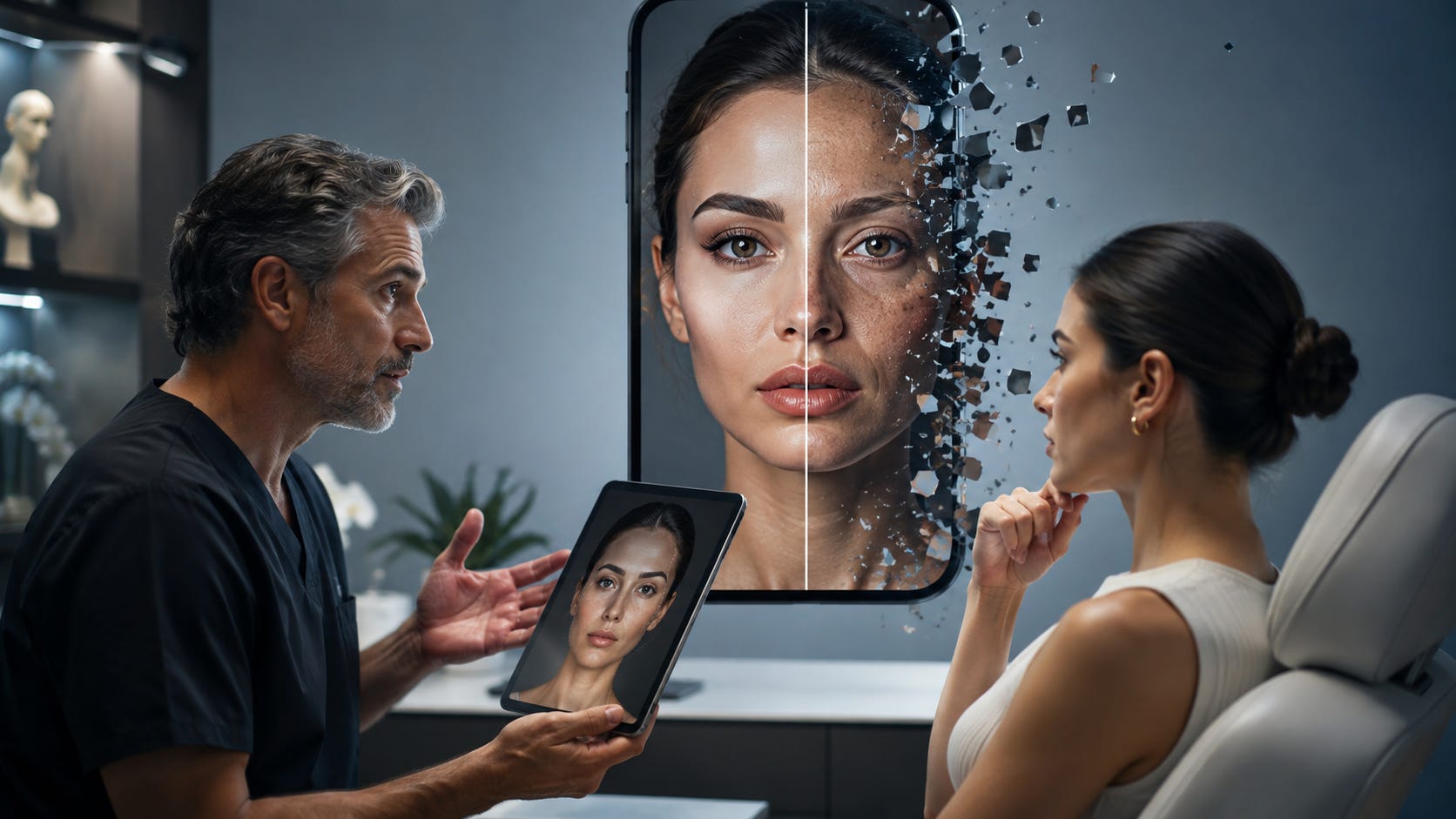
Patients are no longer just bringing celebrity photos into consultations. Many now arrive with edited selfies, filtered videos, or algorithmically enhanced versions of their own face and body. That changes the conversation, because the patient is not asking to resemble someone else; they are asking to become a digitally improved version of themselves.
That distinction matters. Filtered images often smooth skin, change proportions, sharpen contour, narrow the nose, enlarge lips, or lift soft tissue in ways that are subtle on screen but not always achievable, safe, or stable in real anatomy.
The bigger risk is that the digital image starts acting like a promise. Once that happens, every explanation about tissue limits, healing, or tradeoffs sounds to the patient like resistance rather than medical judgment.
What the old approach gets wrong
The traditional response is often informal: the surgeon explains that the image is unrealistic, offers a more conservative plan, and hopes the patient adjusts. Sometimes that works. Often it does not.
The reason is simple. A filter-based request is rarely just a request for a procedure. It is usually a request for certainty, control, and an emotionally loaded visual identity. A casual reassurance is too weak for that kind of expectation problem.
A second problem is the industry environment itself. Research on facial cosmetic surgery photography on Instagram found pervasive photographic bias favoring the postoperative image, which means some patients are being primed by misleading visual norms before they ever enter the office.
The free framework
The fix is not to argue with the filter. It is to replace it with process.
That process has three parts.
1. Use an objective visual baseline
Start with standardized photographs or 3D imaging rather than the patient’s edited reference. This shifts the consultation from fantasy to something measurable and lets the surgeon explain what can change, what cannot, and what falls into a gray zone of partial improvement.
A helpful phrase is: “This image is useful for showing style preferences, but the surgical plan has to be based on your anatomy.” That keeps the patient heard without letting the filter set the target.
2. Explain anatomical reality plainly
Do not rely on vague phrases like “manage expectations.” Be specific. Explain whether the desired change is limited by bone structure, skin thickness, scar behavior, asymmetry, soft tissue volume, or healing variability.
Plain language matters here. A patient who understands why a change is limited is far more likely to accept a realistic plan than a patient who only hears that the surgeon “doesn’t recommend it.”
3. Screen for psychological mismatch
Not every filter-driven consultation points to a psychiatric issue, but some do. The 2025 literature on social media filters and plastic surgery noted higher concern around body dysmorphic disorder and the need for psychological screening in patients influenced by digitally altered ideals.
The key question is not whether the patient wants to look better. It is whether the patient can accept improvement without demanding exact replication of a digitally edited result.
If the answer is no, surgery is usually the wrong next step.
Where the free section ends
The public takeaway is straightforward: do not let a filtered image become the treatment plan. Use objective imaging, explain limits clearly, and slow the case down when expectations are rigid, extreme, or disconnected from anatomy.
