
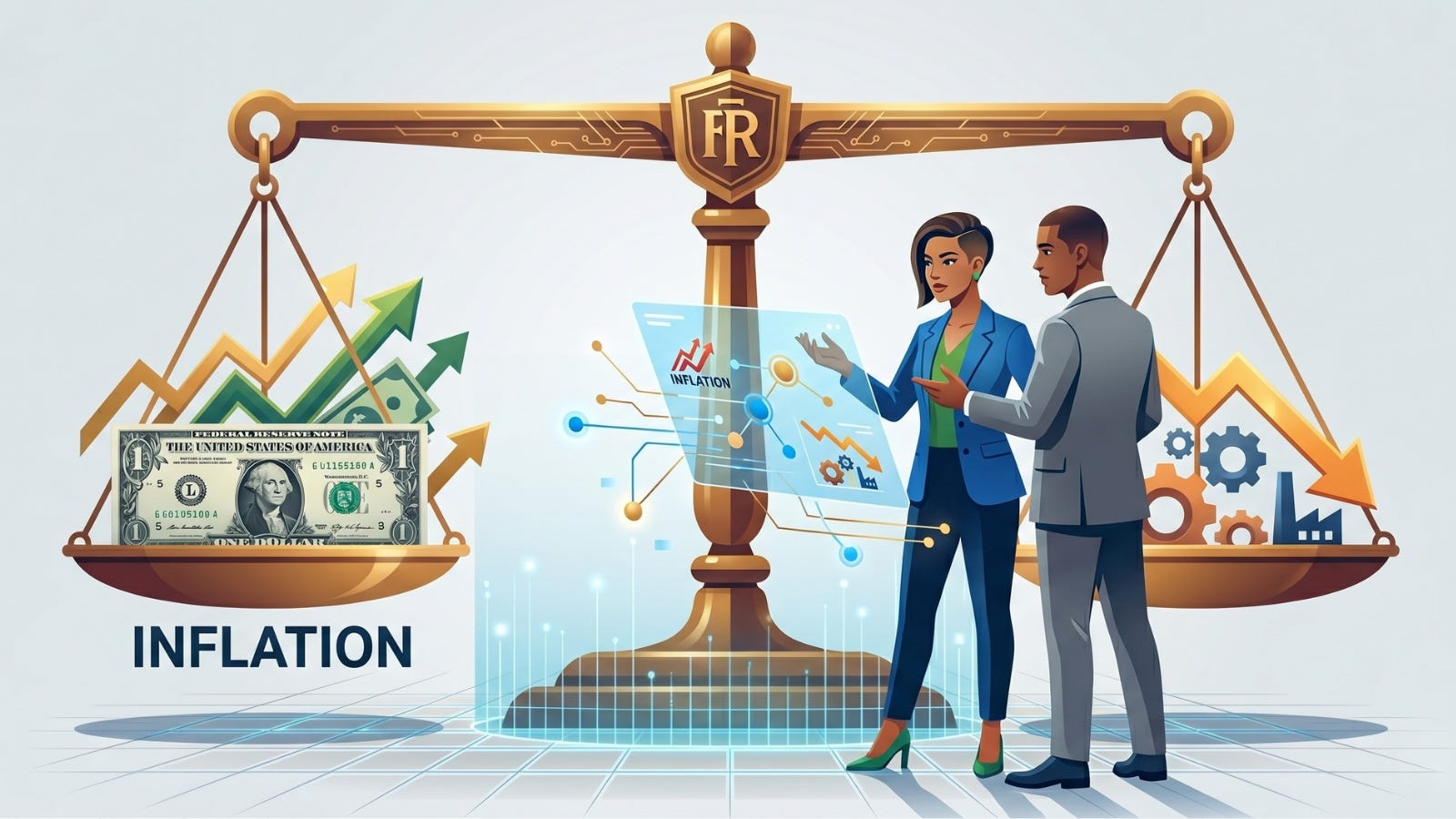
As June 2026 brings heightened divisions within the Federal Open Market Committee (FOMC) and an ongoing debate surrounding economic data flows, businesses are facing a unique stagflation risk—where stubborn price pressures collide with a cooling labor market. This article breaks down how current tariff conversations and the approaching conclusion of Jerome Powell’s term as Fed Chair are complicating corporate forecasting. We explore practical strategies finance leaders can use to position their capital allocations for stability when the macroeconomic data says "cut" but persistent market friction says "hold."
Why Is the Fed Stuck Between Stickier Inflation and a Cooling Job Market?
Corporate capital allocation strategy has hit a structural wall. Data from the Bureau of Labor Statistics (BLS) confirms a dual-mandate friction that hasn’t existed in decades: core consumer prices remain sticky at 3.4%, while the domestic unemployment rate has moved up to 4.0%.
For the last three years, finance leaders could count on a clear, predictable baseline: protect the price stability mandate by keeping interest rates restrictive. However, June 2026 has introduced deep divisions within the Federal Open Market Committee (FOMC). A cooling labor market says “cut rates now to protect jobs,” while persistent core services inflation says “hold rates high to kill price pressures.”
For enterprise finance leaders, this creates a toxic forecasting environment. If you miscalculate your cost of capital based on anticipated Fed cuts that never materialize, you risk over-leveraging into a slowing economy. Conversely, if you pause capital expenditures entirely, you risk losing market share to competitors who optimized their balance sheets early.
The Macro Divergence Matrix
The table below outlines the conflicting data points pulling the FOMC in opposite directions, creating the current strategic paralysis:
MACROECONOMIC INDICATOR SNAPSHOT
Macroeconomic Indicator:
Core Consumer Price Index (CPI)
Current Data State:
3.4% (Target: 2.0%)
Fed Policy Pressure:
Hold / Hawk: Requires sustained restrictive monetary policy.
Corporate Impact:
High debt-servicing costs; persistent input cost inflation.
--------------------------------------------------
Macroeconomic Indicator:
U.S. Unemployment Rate
Current Data State:
Ticked up to 4.0%
Fed Policy Pressure:
Cut / Dove: Requires monetary easing to support job preservation.
Corporate Impact:
Cooling consumer demand; easing wage pressure.
--------------------------------------------------
Macroeconomic Indicator:
Real GDP Growth
Current Data State:
Softened to 1.7% annualized
Fed Policy Pressure:
Cut / Dove: Indicates a broader macroeconomic slowdown.
Corporate Impact:
Top-line revenue compression; inventory buildup risks.
--------------------------------------------------
Macroeconomic Indicator:
Tariff & Trade Volatility
Current Data State:
Escalating global supply-chain friction
Fed Policy Pressure:
Hold / Hawk: Threatens to inject fresh structural inflation.
Corporate Impact:
Higher supply chain risk; pressure on gross margins.
How Does Powell’s Impending Term Expiration Affect Corporate Forecasting?
The Cost of Leadership Discontinuity
Compounding this data dilemma is an administrative timeline shift: Federal Reserve Chair Jerome Powell’s term expires in early 2027. Historically, an impending change in Fed leadership introduces a heavy premium on macroeconomic uncertainty.
When a Fed Chair’s term draws to a close amidst a highly divided FOMC, the central bank’s forward guidance loses its predictive power. Corporate treasurers cannot rely on multi-year rate path modeling because a new appointment could radically shift the committee’s reaction function—either toward tolerating higher structural inflation or executing aggressive monetary easing.
Tariffs and the Structural Shift
Furthermore, current bipartisan conversations regarding expanded trade tariffs are adding a layer of structural friction. Tariffs operate as a supply-side shock—they simultaneously lower economic output and raise prices. This is the literal definition of stagflation.
In a standard cyclical slowdown, standard operating procedure dictates that a company cuts prices to stimulate demand. But when supply chains hit tariff walls and capital costs remain stuck at a 20-year high, your margins get squeezed from both ends.
The Bottleneck: Understanding this macro shift is only half the battle. To actually insulate your operations and execute this strategy, you need a repeatable framework. Below, we break down the exact capital preservation playbooks, synthetic debt-reduction mechanisms, and structural risk metrics used by elite corporate treasuries to survive a dual-mandate deadlock.
