
Quick answer
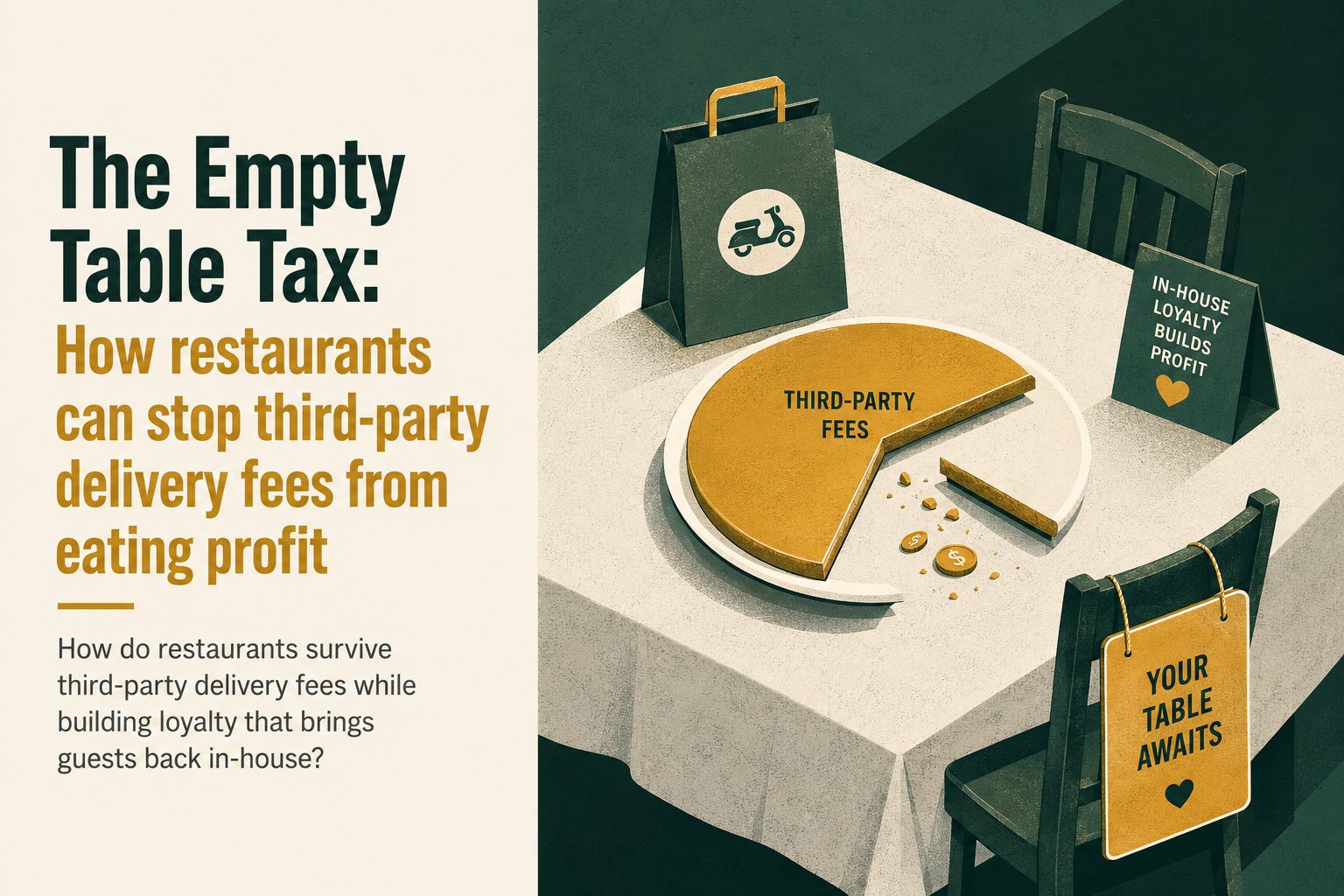
Restaurants can survive delivery-fee pressure by treating third-party apps as acquisition channels, not the core business, then building direct ordering, owned guest data, and loyalty offers that bring people back into their own channels and into the dining room. Delivery commissions often run around 15% to 30% per order, so the profit fix is to reduce dependence on rented demand and increase repeat visits from guests the restaurant can reach directly.
Why it matters
That shift matters because delivery can grow sales while quietly shrinking profit, especially for operators already working on thin margins. Loyalty and direct-order systems matter most when they turn a one-time transaction into a repeat relationship.
In this breakdown
The reality check: Third-party delivery is convenient, but the fee stack often strips out too much margin for it to be the default growth plan.
The utility framework: Build a direct-order and loyalty loop that captures guest permission, identifies repeat buyers, and gives them reasons to return in person.
The tactical output: Focus on a clean direct-order link, a simple loyalty program, follow-up messages, and in-house experiences that make returning feel worth it.
Reality check
The problem is not delivery itself. The problem is letting delivery platforms own the customer relationship and the margin.
Industry coverage in 2026 repeatedly points to commission rates in the 15% to 30% range, which can overwhelm the slim profits many restaurants actually keep.
Traditional thinking says more delivery volume solves the traffic problem. In practice, that can create a dependency loop: more orders, more fees, less cash left to improve the guest experience or buy back repeat traffic.
What to build
A stronger model starts with owned demand, not rented demand. That means direct ordering, a customer list you control, and a loyalty system that rewards repeat behavior instead of chasing every order through a marketplace.
A practical setup includes:
A direct-order button on your website and Google profile.
Permission-based email or SMS capture at checkout.
A simple points or perks program.
Segments for first-time, repeat, and lapsed guests.
Follow-up offers that invite people back for dine-in, not just another delivery.
How loyalty pays
Loyalty works when it is tied to real behavior, not generic discounts. Members tend to visit more often and generate more revenue over time, which is why repeat business is usually more valuable than another one-off order.
The best loyalty programs are also data systems. They show who returns, how often they come back, what they buy, and what kind of nudge gets them to visit again.
In-house experience
If the goal is to pull guests back in-house, the restaurant has to give them a reason that delivery cannot copy. That can mean chef events, limited-time tastings, happy-hour rituals, neighborhood nights, or menu items that only work well when served fresh on-site.
This is where many restaurants leave money on the table. They market convenience when they should be marketing belonging, surprise, and occasion.
A simple operating loop
A guest finds the restaurant through search, maps, social, or delivery.
The restaurant captures contact permission and order history.
The guest receives a useful follow-up, not a random blast.
Loyalty nudges reward repeat visits and special occasions.
In-house experiences give the guest a reason to return physically.
Repeat visits create more margin than another fee-heavy delivery order.
If the free section answers the “what” and “why,” the premium section gives the “how.” This is where the full operating system lives: direct-order setup, loyalty structure, guest-data capture, revisit triggers, in-house demand builders, and the metrics to track each week.
This part is for operators who want a repeatable system, not just a strategy. It shows exactly how to keep more margin, build repeat business, and turn one-time guests into regulars.
