
Quick answer
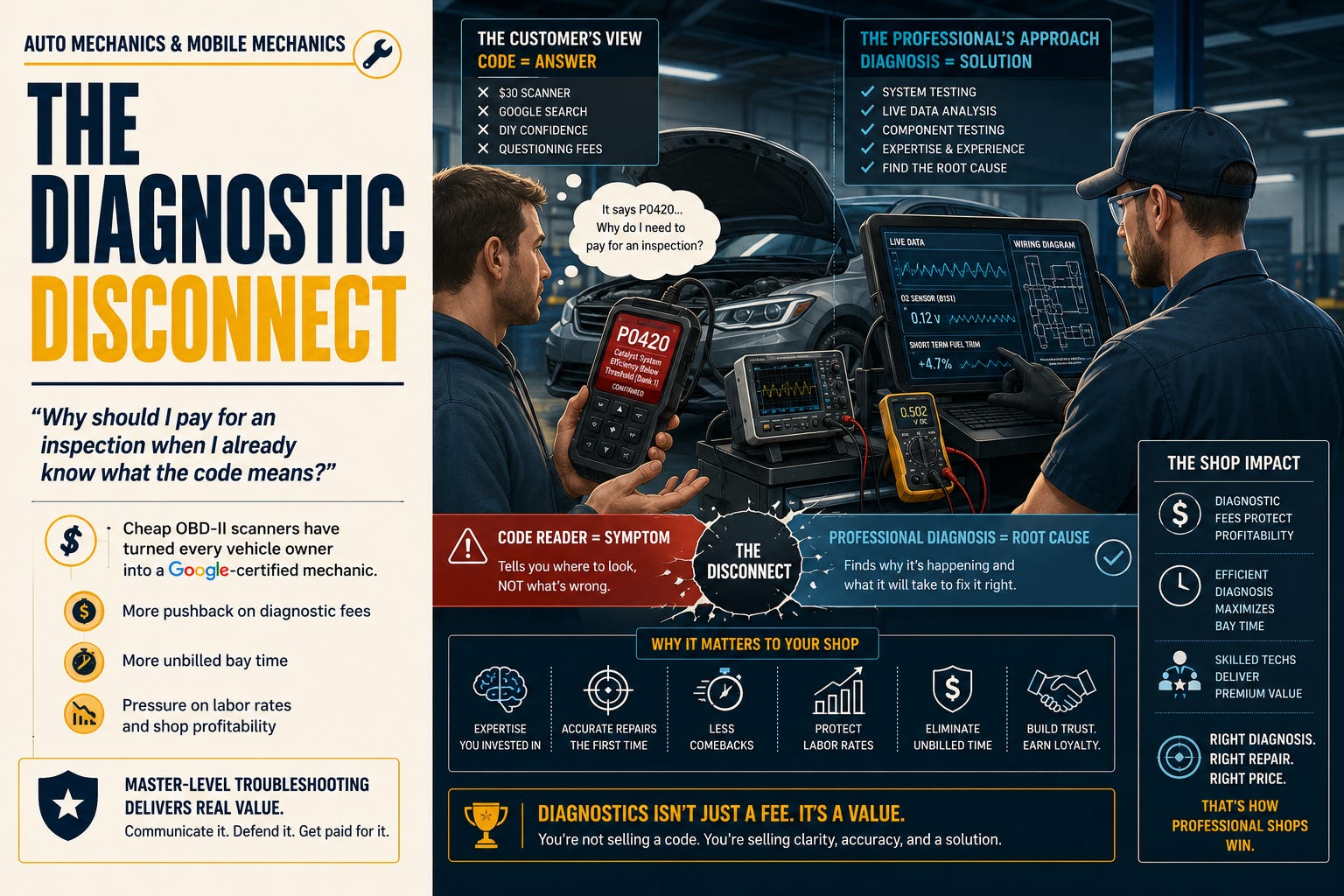
A code reader tells you what the car reported, not why it reported it. Real diagnosis takes technician time, test equipment, interpretation, and verification, which is why shops should charge for it instead of treating it as a free add-on service.
Why it matters
This is where shops lose margin: customers assume the code is the diagnosis, then push back on inspection fees even though code reading alone often cannot isolate the root cause. That pushback creates unbilled bay time and forces technicians to solve problems without being paid for the thinking work.
In this breakdown
The reality check: A trouble code can point to a system, but it rarely proves a single failed part.
The utility framework: Charge for the process of narrowing the fault, not just for plugging in the scanner.
The tactical output: Use a simple explanation that separates code retrieval from diagnosis, then back it with a clear diagnostic policy and written estimate.
Reality check
Cheap OBD-II readers have made code retrieval feel like diagnosis, but that shortcut breaks down as soon as the fault involves wiring, intermittent behavior, multiple systems, or a part that fails only under load. Consumer scanners can surface common codes, but those codes are often just the starting point for actual troubleshooting.
Shops also have to price the work like work. Diagnostic time is a billable service, and repair labor is already treated as a professional service, not a commodity add-on.
Why codes mislead
A code says the vehicle detected a condition, not the exact fix. For example, a lean code can be caused by vacuum leaks, fuel delivery problems, sensor faults, or exhaust issues, which means swapping the first part the code suggests can waste time and money.
That gap is the whole sales problem. Customers often think, “I already know the code,” while the shop is actually being asked to determine whether the code is the symptom, the consequence, or the real failure.
How to price diagnosis
The cleanest message is simple: code reading is fast, diagnosis is skilled labor. Diagnostic fees are payment for the labor required to determine the cause of the concern, which gives shops a straightforward way to justify the charge.
A useful rule is to quote diagnosis as a separate line item, define what is included, and avoid implying that a code scan equals a repair plan. Shops need to protect billed time, not donate it.
Customer script
Use language like this:
“The code tells us where to start, not what part to replace.”
“We charge for diagnosis because the real work is confirming the cause.”
“If it turns out to be a simple fix, great. But we still have to verify it properly.”
“A scanner gives information. The technician gives the answer.”
That framing keeps the conversation professional and avoids arguing about whether the customer already did part of the job. It also makes it easier to defend your labor rate because the customer is paying for a result, not a guess.
