
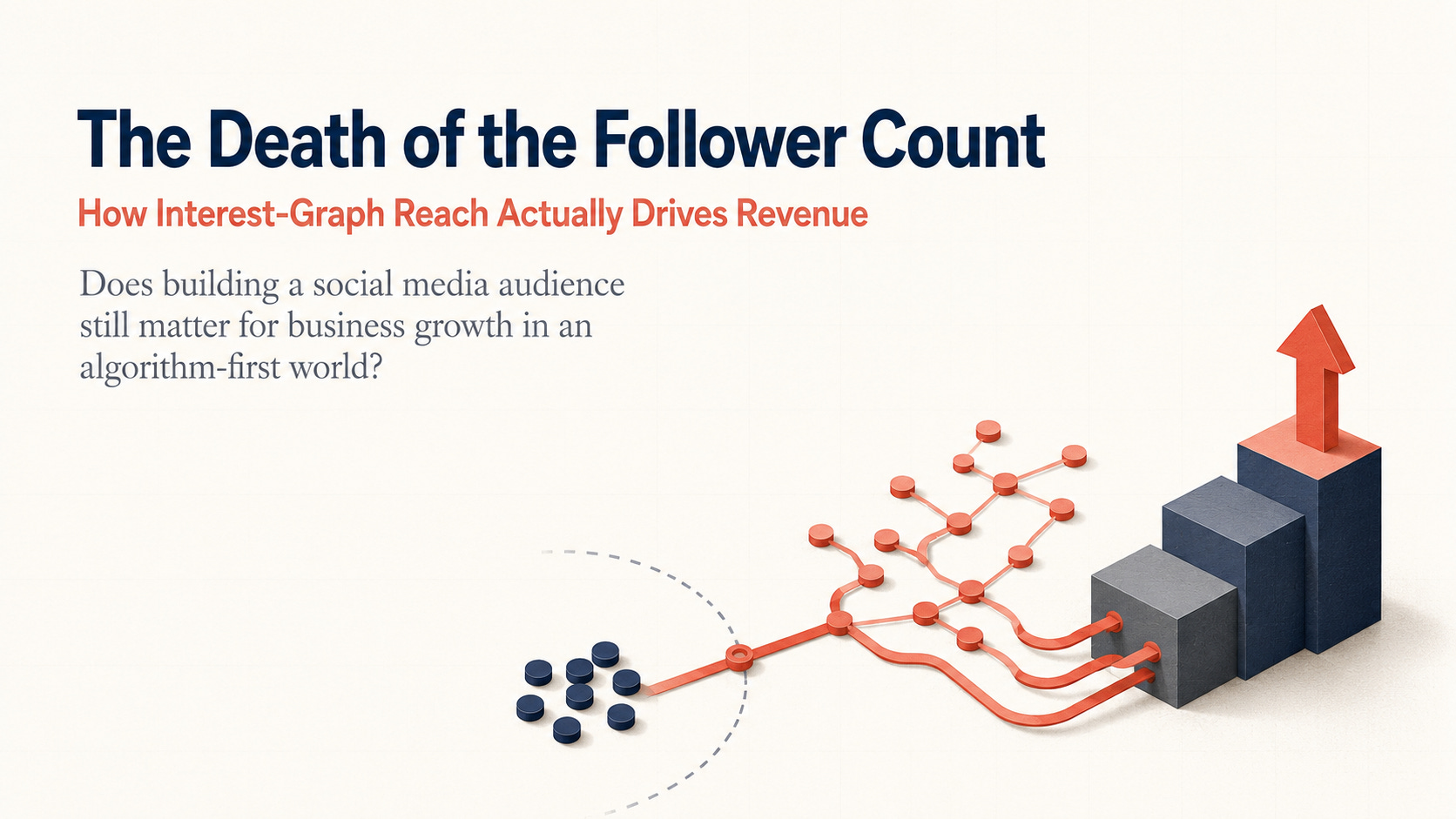
A large following can strengthen credibility, community, and repeat exposure, but it no longer guarantees distribution. Major platforms now combine social connections with behavior-driven recommendations, allowing one useful post to reach interested non-followers. This guide explains how businesses can turn that discovery into qualified traffic, leads, and measurable revenue.
Quick Answer
Yes, building an audience still matters—but follower count is no longer the best measure of potential reach or business value. Modern feeds can recommend content to people who have never followed the account. Businesses should therefore optimize each post for qualified attention and measure visits, leads, customers, and revenue alongside audience growth.
What Is an Interest Graph?
An interest graph connects people with content based on what they appear likely to watch, read, save, share, search for, or act on.
A traditional social graph is built around relationships: friends, followers, professional connections, group memberships, and subscriptions.
Most major platforms now use a mixture of both.
Your connections still influence what appears in your feed, but so do your viewing history, searches, interactions, stated preferences, and predicted interest in a subject. That means someone who has never heard of your business may see your post before an existing follower does.
The Follower Count Isn’t Dead—Its Monopoly Is
The headline is deliberately sharp. The more accurate conclusion is this:
Follower count has lost its position as the main proxy for organic reach.
TikTok says its For You system ranks videos using signals such as user interactions, video information, and certain account or device settings. It also says that follower count is not a direct recommendation factor, although accounts with larger audiences may receive more initial views. TikTok’s explanation of its For You recommendations supports the shift toward behavior-based discovery.
YouTube also uses viewing behavior and satisfaction signals. Its recommendation system considers whether people choose to watch, how long they watch, and whether they appear satisfied. YouTube says its systems rely more heavily on video- and audience-level signals when deciding what to recommend. YouTube’s performance guidance makes clear that each video’s reception matters.
Subscriptions still have value, but subscriber count and active audience are not the same thing. YouTube specifically describes monthly audience as a more accurate estimate of active viewers because it measures who actually watched, not merely who once subscribed. YouTube’s audience guidance confirms that distinction.
Instagram uses separate ranking systems across Feed, Stories, Explore, and Reels. Its published explanation includes signals about the post, the creator, the viewer’s activity, and the viewer’s interaction history. Instagram also acknowledges follower count as one possible popularity signal, so it would be inaccurate to say followers have no influence. Instagram’s ranking explanation supports a hybrid model.
LinkedIn operates similarly. Its feed includes posts from connections, followed accounts, groups, and sources outside a member’s network. LinkedIn says its systems use profile information, network relationships, post context, interests, and activity to personalize distribution. LinkedIn’s feed-ranking documentation confirms that professional connections still matter alongside behavioral signals.
The evidence does not support saying that every platform has completely replaced its social graph. The defensible conclusion is that major platforms increasingly operate hybrid distribution systems in which relationships matter, but predicted relevance can carry content far beyond an account’s followers.
Why Follower Count Can Be Misleading
Many businesses still treat social media like an email list:
Build followers.
Publish an announcement.
Assume most followers will see it.
Judge the result by likes.
That model breaks when only part of the follower base receives a post and some impressions come from people who do not follow the account.
Follower count alone cannot tell you:
How many followers remain active
How many match your current target customer
How many saw a particular post
How many understood the offer
How many visited your website
How many became qualified leads
How many eventually purchased
A business can have 100,000 followers and weak sales. Another can have 3,000 followers, reach the right non-followers, and generate a steady stream of inquiries.
The difference is not audience size alone. It is commercial relevance.
The Post Has Become a Unit of Distribution
In a recommendation-driven feed, each post must earn its own distribution.
The platform is attempting to predict:
Who is likely to care about this subject?
Will the opening earn attention?
Will people continue watching or reading?
Does the content fulfill the promise made by the hook?
Do viewers save, share, discuss, or respond positively?
Should the post be shown to more people?
This is why standalone content matters.
A stranger should be able to understand a post without recognizing your company, knowing your terminology, or seeing an earlier installment.
Compare these openings:
Here is another important lesson we learned.
That provides almost no context.
Three reasons profitable businesses still run short of cash.
The second opening immediately identifies the subject, problem, and intended audience.
Reach Does Not Automatically Produce Revenue
Interest-graph distribution creates an opportunity. It does not guarantee a sale.
Revenue depends on what happens after the impression:
Qualified impression → meaningful engagement → profile or website visit → lead → sales conversation → purchase
A post can go viral and still fail commercially if it attracts the wrong audience, has no connection to an offer, or leaves viewers without a useful next step.
A smaller post may be more valuable when it reaches people actively experiencing the problem your business solves.
An accounting firm, for example, does not necessarily need one million views on a motivational post. It may gain more from 15,000 views on a clear explanation of why profitable companies run short of cash—especially if interested owners can continue to a cash-flow worksheet, newsletter, or consultation.
Replace Vanity Metrics With Business Metrics
Follower count can remain on the dashboard, but it should not sit alone at the top.
The Content Metrics That Actually Matter
Qualified Reach
Shows whether your content reached people who are relevant to your business—not just a large general audience.
Non-Follower Reach
Reveals whether the platform distributed your content beyond the people who already follow you.
Watch Time or Completion Rate
Measures whether your content held viewers’ attention long enough for them to receive the message.
Saves and Shares
Shows whether people found the content useful enough to keep for later or send to someone else.
Profile Visits
Indicates whether the post made viewers interested enough to learn more about its creator or business.
Link Clicks
Tracks whether viewers took the next step you asked them to take.
Landing-Page Conversion Rate
Measures whether the destination delivered on the post’s promise and persuaded visitors to act.
Qualified Leads
Shows whether the content attracted people who may realistically become customers.
Customers Acquired
Tracks how many viewers eventually became paying customers.
Attributed Revenue
Estimates how much revenue can reasonably be connected to the content or campaign.
One useful efficiency metric is:
Revenue per 1,000 impressions = Attributed revenue ÷ Impressions × 1,000
Consider this hypothetical comparison:
Post A vs. Post B: Which One Performed Better?
Post A
Impressions: 200,000
Qualified leads: 20
Customers acquired: 2
Attributed revenue: $1,000
Revenue per 1,000 impressions: $5
Post B
Impressions: 25,000
Qualified leads: 35
Customers acquired: 5
Attributed revenue: $4,000
Revenue per 1,000 impressions: $160
Key Takeaway
Post A generated eight times more impressions, but Post B produced more leads, more customers, and four times more revenue.
Post B generated $160 per 1,000 impressions, compared with only $5 for Post A. That makes Post B 32 times more efficient at generating revenue from attention.
A larger audience does not automatically produce better business results. The quality and intent of the audience matter more than the raw impression count.
Post A attracted more attention. Post B created more business value.
This does not mean revenue can always be tied perfect
ly to a single post. A person may watch a video, search for the company later, join its email list, and purchase several weeks afterward. Attribution should therefore be treated as a useful estimate, not absolute proof of causation.
The free-tier lesson is simple: followers still matter, but sustainable growth comes from reaching the right people and giving them a relevant next step.
Upgrade to the paid tier for the complete interest-graph content system, revenue-tracking framework, publishing workflow, and subscriber-only discussion below.
