
Quick answer
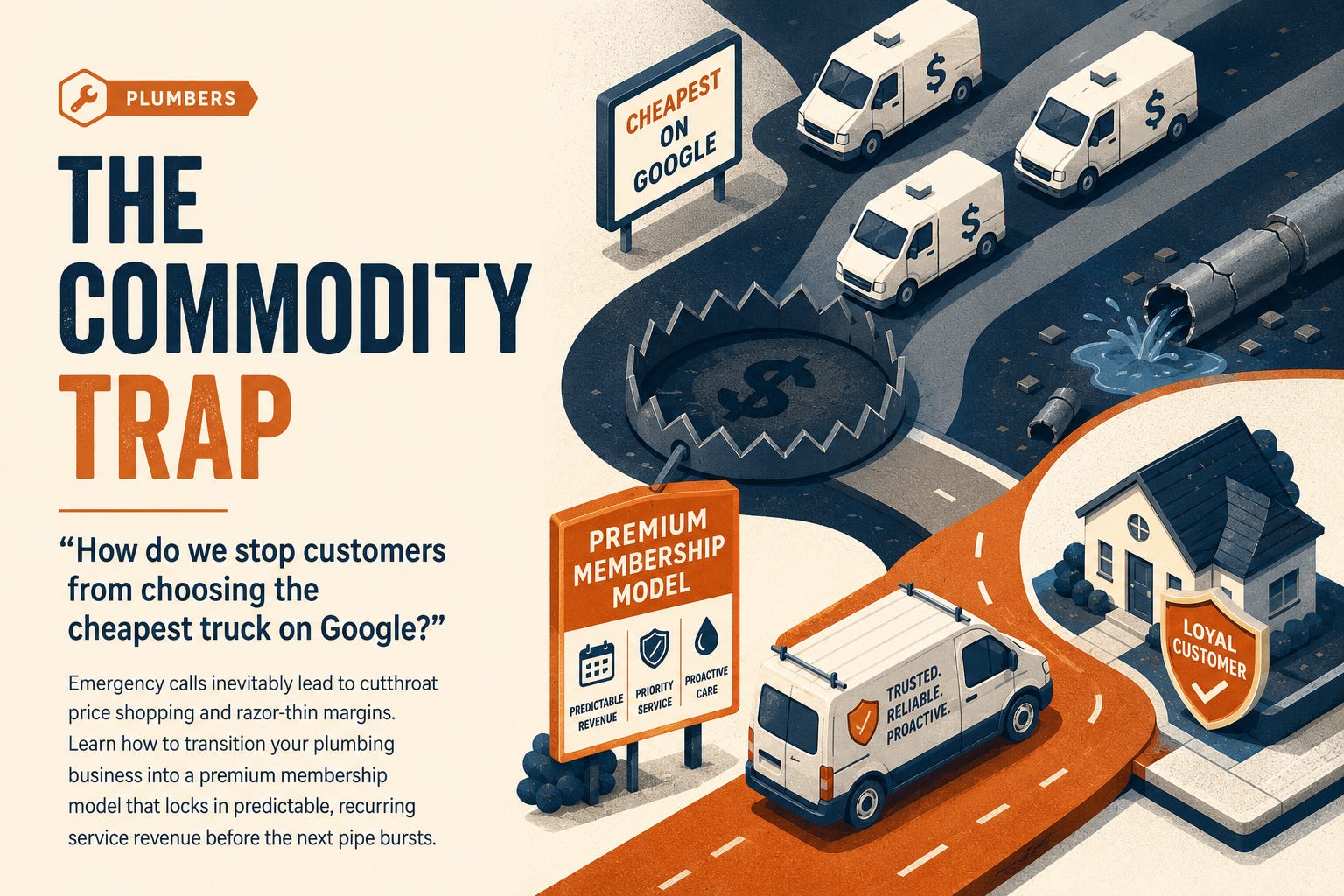
Plumbing companies stop competing as a commodity when they stop selling only one emergency at a time. A membership plan that bundles inspections, priority service, and repair discounts changes the customer relationship from “find a plumber now” to “call our plumber first,” while creating predictable recurring revenue before the next pipe bursts.
Why it matters
Emergency plumbing demand looks profitable, but it often creates unstable revenue and constant price comparison. Membership programs give plumbing businesses a way to smooth cash flow, improve retention, and create a more defensible relationship with the homeowner than a one-time service call can.
Reality check
Most residential plumbing shops are still organized around interruption. The lead comes in when something leaks, backs up, or breaks, and the company gets one shot to win the job before the customer clicks the next listing. That system keeps the phones busy, but it also trains the market to compare plumbers on speed and price rather than trust and continuity.
This is the real problem with Google-driven emergency work: the customer is shopping at the worst possible moment. They are stressed, they want the issue gone fast, and they usually do not have enough context to compare workmanship, process, or long-term value. Price becomes the shortcut.
That is the commodity trap. The business is necessary, visible, and still treated like a near-interchangeable service.
Memberships solve that by changing the timing of the relationship. Instead of showing up only when something is broken, your company stays present between failures. That makes you harder to replace when the urgent moment comes. Plumbing service-plan templates and contractor membership platforms are built around this exact logic: recurring service, priority access, and discounts that make the plumber the default choice rather than the emergency option.
What a plumbing membership actually is
A plumbing membership is a recurring service agreement. The customer pays monthly or annually, and in return they get a defined set of benefits such as inspections, maintenance reminders, priority scheduling, waived or reduced service-call fees, and discounts on repairs.
In plain English, it is a way to turn plumbing from a panic purchase into a relationship product. The homeowner is no longer hiring a stranger every time there is a problem. They are paying to keep a trusted provider close by.
That matters because recurring plans create value for both sides. For the customer, the benefit is peace of mind, cost predictability, and a lower chance of missing small issues before they become expensive ones. For the company, the benefit is steadier revenue and more opportunities to catch profitable work during routine touchpoints rather than waiting for random emergencies.
Why this works better than discounting
Discounting can win a job, but it rarely builds a better business. Once price becomes your strongest sales argument, you have trained the customer to leave as soon as someone else is cheaper.
A membership changes the decision criteria. The customer starts to care about:
Who already knows the home.
Who can prioritize the call.
Who has a maintenance record.
Who offers savings beyond a one-time coupon.
Who feels safer to call when the next problem shows up.
That is why membership programs are so attractive in home services. Recent contractor coverage argues that structured membership programs can materially increase recurring revenue and profit, especially when paired with recurring billing, plan management, and consistent offer presentation. One 2026 contractor software overview notes that 500 members at $99 per year equals $50,000 in recurring revenue before any repair work is sold, and 2,000 members would equal $200,000 on plan revenue alone. Membership-focused consulting coverage also reports that well-run programs in established home-service businesses can generate $100,000 to $300,000 in annual recurring revenue.
The point is not that every plumbing shop will hit those numbers quickly. The point is that price-shopping businesses rarely stumble into predictable revenue by accident. They build it by design.
The three-part framework
1. Build one offer customers understand immediately
The biggest mistake most plumbing businesses make is overcomplicating the plan. They create too many tiers, too many exceptions, and too much jargon. That makes the plan harder to sell and harder to fulfill.
The better move is to start with one clean, easy-to-explain offer. Housecall Pro’s plumbing service-plan examples show a range from a free starter plan to good, better, and best options, but the operational lesson is simple: the plan needs a clear promise, visible benefits, and a billing structure the customer can understand fast.
A strong starter offer often includes:
One annual plumbing inspection.
Priority scheduling.
A repair discount.
A maintenance benefit such as a water-heater flush or sump-pump inspection.
Seasonal reminders and digital maintenance records.
If the technician cannot explain the plan in 20 seconds, it is too complicated.
2. Price the plan for retention, not just immediate margin
The membership fee should not be judged like a one-time repair ticket. Its job is larger than that. It should create recurring income, increase customer lifetime value, and pull more work into your pipeline before competitors get a shot.
That means pricing should reflect:
The cost of included visits.
The likely use of discounts.
The convenience value to the homeowner.
The expected follow-on work created by regular inspections.
Current service-plan software guidance emphasizes setting number of visits, plan duration, billing cadence, and automatic discounts deliberately rather than improvising them. Housecall Pro’s workflow explicitly includes plan description, included visits, payment options, add-ons, and billing cadence as core setup decisions.
In other words, price is not just a marketing decision. It is an operating decision.
3. Make the plan part of the service process
A membership that lives on a website page but never gets offered in the field is not a growth strategy. It is a brochure.
The plan has to show up in the actual service flow:
The CSR mentions it during booking.
The technician mentions it during or after diagnosis.
The invoice or job-close process includes the opportunity to enroll.
The system sends reminders so members use the benefits they paid for.
Housecall Pro’s plumbing checklists explicitly include “Offer maintenance plan/VIP/Loyalty program” as part of the service-call checklist, which is a useful reminder that memberships have to be operationalized, not just marketed. Service-plan tools also emphasize recurring billing management, renewal handling, and plan maintenance as part of the workflow, which means your internal process matters as much as the offer itself.
PLUMBING MEMBERSHIP VALUE COMPONENTS
Component:
Annual Plumbing Inspection
Why It Matters:
Creates a proactive relationship and surfaces issues before they become urgent.
======================================================================
Component:
Priority Scheduling
Why It Matters:
Gives the customer a reason to stay loyal when something goes wrong fast.
======================================================================
Component:
Repair Discount
Why It Matters:
Makes the plan feel financially tangible at the moment of purchase.
======================================================================
Component:
Water-Heater Flush or Sump-Pump Check
Why It Matters:
Adds visible maintenance value beyond a vague “VIP” promise.
======================================================================
Component:
Maintenance Reminders
Why It Matters:
Keeps the member engaged between visits.
======================================================================
Component:
Digital Service Record
Why It Matters:
Increases professionalism and reinforces continuity.
Common mistakes
Most plumbing membership plans fail for boring reasons, not dramatic ones.
The offer is too confusing.
The team is not trained to mention it consistently.
The price is chosen without modeling usage and discounts.
The plan is sold once and then ignored, so members forget the value.
The business expects the plan itself to be the profit center instead of seeing it as the retention engine.
Where the free section ends
The strategic answer is straightforward: stop selling only emergency response and start selling ongoing protection. That is how a plumbing company stops being judged like the cheapest truck in a search result and starts acting like a trusted utility inside the home.
The harder part is implementation. Pricing, scripts, billing setup, team adoption, reactivation campaigns, and retention systems are where the membership model either compounds or stalls. Current service-plan tooling makes those backend choices explicit, from billing cadence to included visits to renewal administration.
