
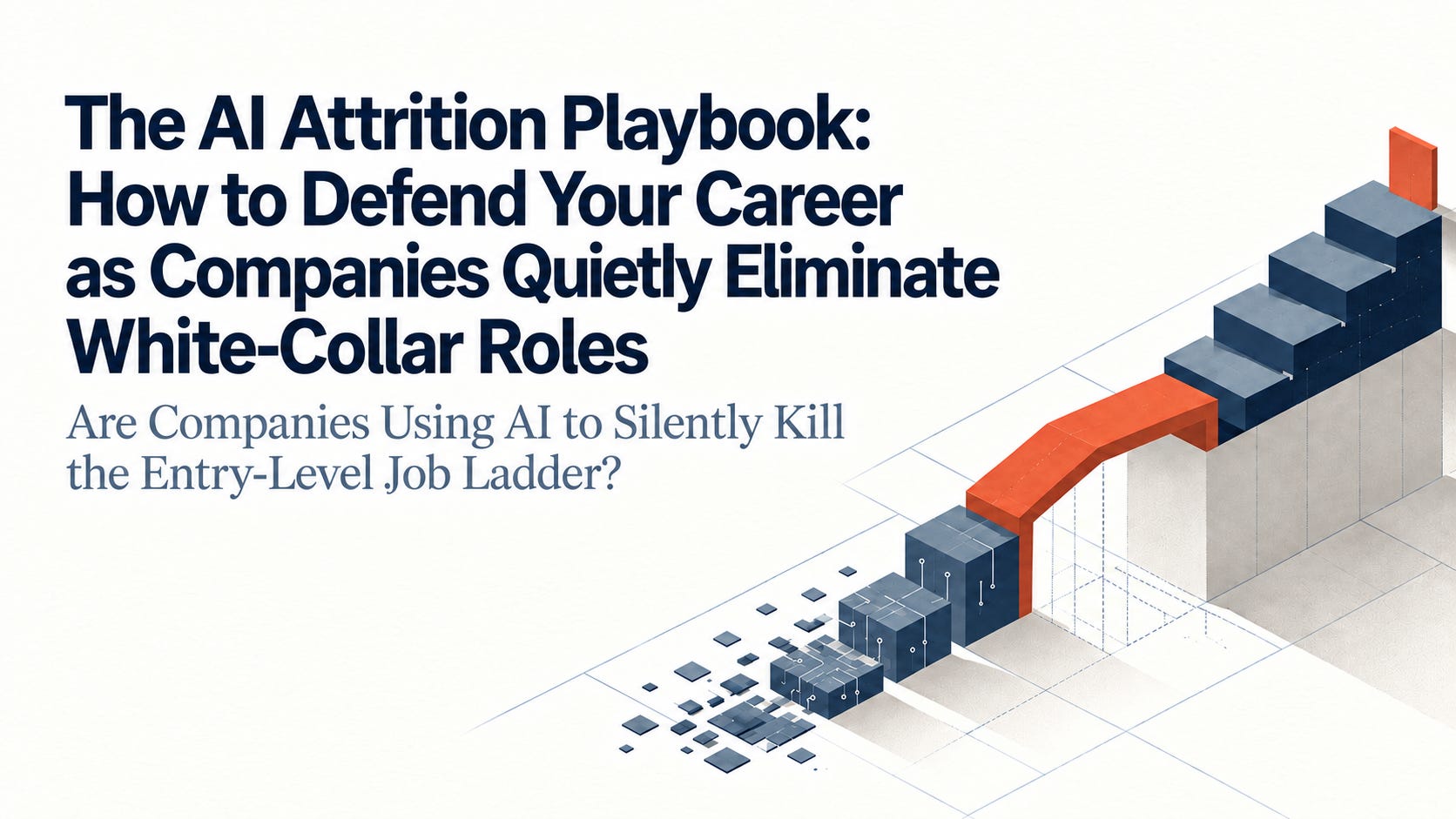
Employment for young workers in AI-exposed jobs is 19% below its peer benchmark. The cause is contested. The defense isn't. Image: org-chart-ladder, 1200 x 628 Alt text: An illustrated ladder shaped like a corporate org chart, with the three lowest rungs missing while the upper rungs remain intact and occupied.
Quick answer
The entry-level white-collar ladder is losing rungs, but it is being dismantled by a hiring freeze rather than by layoffs. Employment among 22-to-25-year-olds in the most AI-exposed occupations now sits about 19% below where it would be had it tracked their less-exposed peers, and that gap comes almost entirely from reduced hiring rather than increased separations. Whether AI is the cause is still contested: the Federal Reserve Bank of New York attributes most of the damage to remote work instead.
What AI attrition actually looks like
Call it AI attrition: workforce reduction achieved by not hiring. No announcement, no WARN notice, no severance line. A junior analyst leaves, the requisition is closed rather than reposted, and the remaining team absorbs the volume with software. Headcount falls. Nothing is ever declared.
This is the dominant mechanism in the 2026 white-collar labor market, and it is nearly invisible in the data most people watch.
The current state
Most coverage of AI and employment tracks layoff announcements. That is the wrong instrument. Announced cuts through August 2026 total 529,914, down 41% from the same period in 2025, according to Challenger, Gray & Christmas. Strip out the government sector, which distorted last year’s totals, and cuts are still down 15%. By the layoff meter, this is a quiet year.
Now look at who is not being hired.
The Federal Reserve Bank of New York’s tracker for recent college graduates puts unemployment for 22-to-27-year-old degree holders at roughly 5.6% through the second quarter of 2026, with underemployment at 42%. Those are not recession numbers. They are stagnation numbers, and they have barely moved in four quarters.
Indeed’s Hiring Lab found the market tilting toward seniority: senior-level postings rose almost 15% between May 2025 and May 2026, while entry- and mid-level postings managed only slight upticks. In software development, senior roles accounted for 69.3% of Q1 2026 postings. Entry-level accounted for 4.5%.
The 19% gap
The sharpest measurement comes from payroll records rather than surveys. In the August 2026 revision of “Canaries in the Coal Mine?”, Erik Brynjolfsson, Bharat Chandar and Ruyu Chen of the Stanford Digital Economy Lab report that employment among workers aged 22 to 25 in highly AI-exposed occupations now sits about 19% below where it would be had it kept pace with similarly aged workers in less-exposed occupations. A year earlier the same measure read 15%.
The underlying levels are worth sitting with. Between November 2022 and June 2026, employment for that age group in the two most exposed occupational quintiles fell roughly 11%. In the three least exposed quintiles, it grew roughly 10%. Same cohort, same economy, opposite directions.
Four further findings from the same paper matter more than the headline number:
Experienced workers show no comparable gap. This is not a white-collar recession. It is an entry-level one.
The adjustment runs through reduced hiring, not increased separations. Firms are not removing juniors. They are declining to add them.
Declines concentrate where AI usage automates rather than complements. Where AI is used alongside workers, employment is flat or rising, particularly for experienced staff.
Pay has not adjusted. So far the shock shows up in employment counts, not base salaries.
The revision also introduces the distinction that should govern how you assess your own role: codified versus tacit knowledge. Employment fell among young workers in occupations built on formal, documented, teachable knowledge. It rose among experienced workers in occupations built on judgment accumulated through practice, mentorship and repeated exposure to messy situations.
Generative models are very good at reproducing what has already been written down. They are much weaker at what was never written down in the first place.
The counter-evidence, which you should take seriously
Three things cut against a simple AI-did-it story, and a playbook built on a false diagnosis is worse than no playbook.
Causation is unsettled, and the authors say so. Stanford presents these as descriptive patterns, not causal estimates. The gaps shrink when education is controlled for. Some divergent trends predate generative AI. The effect is larger in the ADP sample than in national survey benchmarks.
A competing explanation accounts for most of the damage. On June 1, 2026, Natalia Emanuel, Emma Harrington and Amanda Pallais published research through the New York Fed estimating that remote work explains 64% of the recent rise in unemployment among young college graduates. Their mechanism: distributed work makes juniors harder to train and mentor, so firms grow reluctant to hire them. Working with data from a Fortune 500 company, they found software engineers received about 20% more feedback when seated near colleagues. The timing of the youth unemployment surge fits remote adoption better than it fits AI adoption, and the age gap persists even holding AI exposure constant.
Executive expectations are running far ahead of executive behavior. McKinsey’s State of AI survey, fielded May 4 to June 8, 2026 across 1,719 respondents in 97 countries, found that just 14% of respondents at AI-using organizations said AI contributed to a decline in total workforce size over the past year. In the prior year’s survey, 32% had expected exactly that. Two-thirds reported little or no AI-related change at all, and in every single business function McKinsey asked about, the share reporting actual reductions came in below the share that had predicted them. Now 39% expect declines in the coming year, a number the prior year’s track record says to discount heavily.
Challenger’s own data makes the same point. AI led all stated reasons for job cuts for five consecutive months from March through July 2026. In August it fell to fourth, with 3,462 cuts against restructuring’s 16,173. Year to date AI remains the leading cited reason at 116,175 announcements, about 22% of the total. But “cited reason” is a company’s framing of its own decision, not an audited finding.
What is happening to the people who stay
One number from the McKinsey survey deserves more attention than it has received. Among mid-level managers and individual contributors, 47% reported experiencing an AI-related strain at work. Among executives and senior managers, 31% did.
That is the absorption showing up in the data. The work does not disappear when the requisition closes. It redistributes downward onto people who were already at capacity, while the people authorizing the freeze experience it as an efficiency gain.
The way forward
Put it together and a defensible position emerges.
The threat is real but narrower than the discourse. It concentrates on early-career workers in occupations where the work is codified, and it operates through the hiring pipeline rather than the exit door. The cause is genuinely contested between automation and the collapse of in-person apprenticeship.
Here is the useful part: both explanations point to the same defense. Whether your junior role vanished because a model absorbed the codified work or because remote work made you too expensive to train, what protects you is identical. Accumulated judgment that was never written down, and proximity to the people who can transfer it.
That is the pivot. Stop optimizing to be the person who produces the output. Start optimizing to be the person accountable for whether the output is right.
The tactical question is how you do that from wherever you currently sit. That is the rest of this piece.
Below the paywall: the three-part exposure audit you can run on your own role this week, the five moves that shift you from the automated track to the augmented one, the ninety-day benchmarks that tell you whether it's working, and the four pitfalls that make people less safe while feeling more prepared. Paid subscribers can take questions to the discussion thread at the end.
