
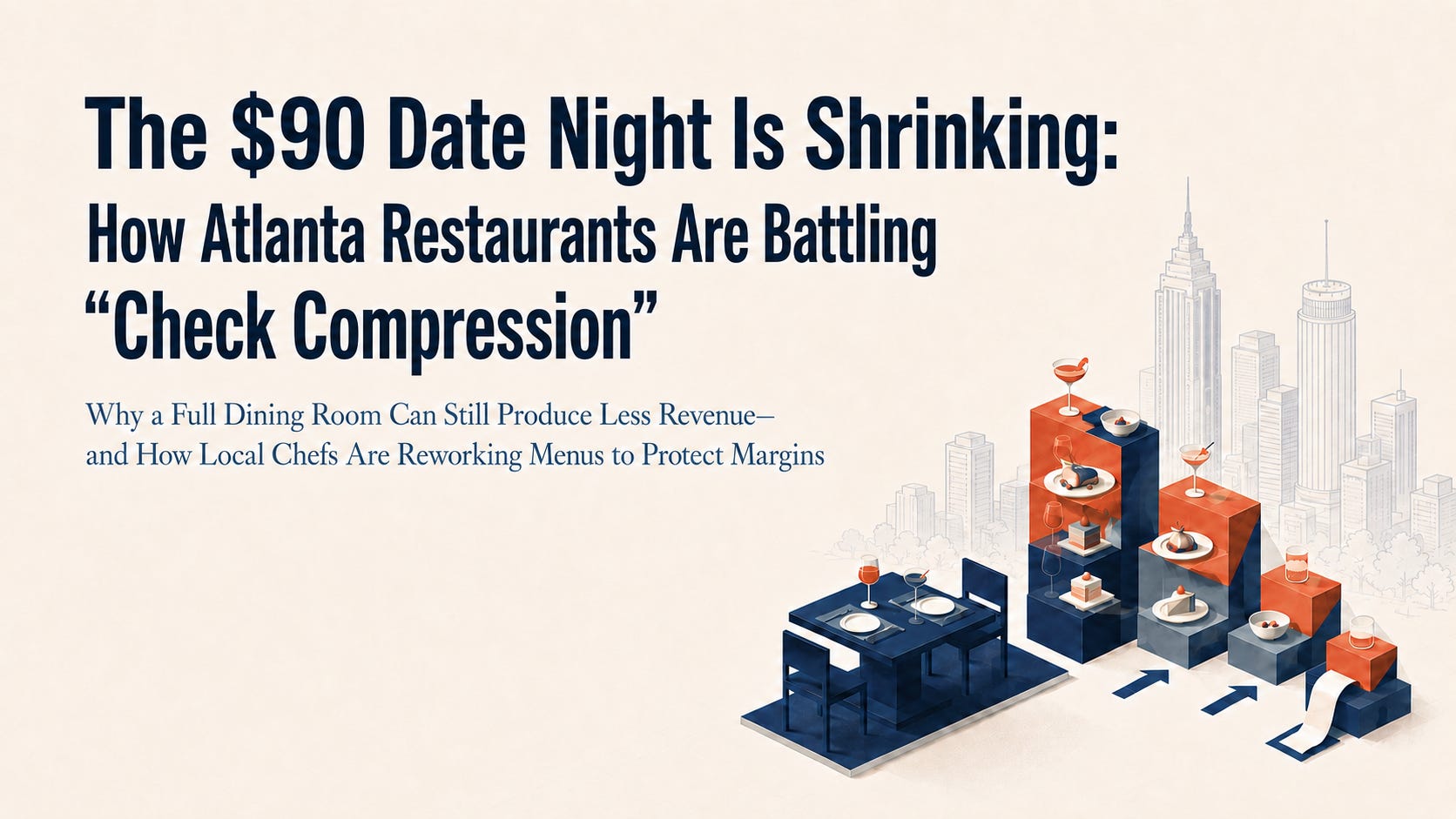
Atlanta diners have not stopped going out. What has changed is how some guests spend once they sit down: one less cocktail, no dessert, a shared dish, or a lower-priced time slot. That smaller check can turn a busy service into a soft sales night. Here is how local operators can build value into the menu without giving away the margin.
Reporting note: Prices, policies, and local examples were verified on August 19, 2026. Restaurant menus and promotions may change.
Quick Answer
Check compression is a drop in sales per guest, even when traffic holds steady. The fix is not a blanket price increase or discount. First find out whether guests are cutting drinks, courses, premium dishes, or visits. Then redesign that part of the menu around clear value and contribution dollars. The $90 example is illustrative, not an Atlanta average.
What Check Compression Actually Means
Check compression is a decline in average guest spending. A couple may still book the table, order dinner, and stay for ninety minutes. But if they drop one cocktail, skip dessert, or choose the lower-priced entrée, the restaurant earns less from the same seats and much of the same labor.
That is why a dining room can look healthy while the nightly numbers weaken. Occupancy is a snapshot. It does not show how many times each seat turned, what each guest ordered, or how much contribution margin the menu mix produced.
The distinction matters in Atlanta because restaurant prices have continued to rise. In June 2026, the food-away-from-home index for the Atlanta-Sandy Springs-Roswell area was 5.9% higher than a year earlier, according to the U.S. Bureau of Labor Statistics. BLS cautions that local indexes use smaller samples and can be more volatile than national figures, so this is a market signal—not a substitute for a restaurant’s own numbers.
Diners see higher prices on the menu. Operators feel the squeeze through food, payroll, rent, utilities, insurance, and card-processing costs. The National Restaurant Association estimates that total expenses for an average restaurant rose 36% between 2019 and 2026. A price increase may protect top-line sales while prompting guests to remove profitable extras from the order.
The Pressure Is Coming From Both Sides
Nationally, the restaurant industry remains active, but traffic has been uneven. The National Restaurant Association reported that June 2026 was the sixteenth month out of the previous seventeen in which operators reported a net decline in customer traffic. A 2025 YouGov dining survey found that 37% of Americans said they were eating out less often than the year before.
That does not mean the whole industry is in free fall. U.S. eating-and-drinking-place sales were 5% higher in July 2026 than a year earlier, or 1.6% higher after adjusting for menu-price inflation. The market is growing, but not evenly.
The guests who still go out may protect the occasion while trimming the order. That behavior is especially painful for full-service restaurants because the skipped items—cocktails, appetizers, desserts, and second rounds—often help carry the economics of the table.
Margins leave little room for error. In the National Restaurant Association’s 2025 operations study, full-service respondents reported median income before taxes equal to only 2.8% of sales in 2024. Labor, including benefits, represented a median 36.5% of sales. Those are national medians, not targets for every restaurant, but they show why a small change in ordering behavior can matter. The Association’s full summary is available here.
What Atlanta Restaurants Are Already Testing
There is no public dataset showing that every busy Atlanta restaurant has a shrinking check. Each operator has to prove that with its own point-of-sale data. What local reporting does show is a clear push toward more affordable ways to dine.
In September 2025, Rough Draft Atlanta reported several examples: Bar Avize offered a $20 comfort-food-and-mini-martini special; Ticonderoga Club revived Captain B’s Fish Camp on slower nights; Chef Deborah VanTrece added a $15 lunch blue-plate special at Twisted Soul; and Lazy Betty offered shorter tasting experiences at the bar alongside its full dining-room menu.
Those offers may have changed since they were reported. The useful lesson is the structure: keep the premium experience, then add a more accessible way into it.
That pattern has continued into 2026. Rough Draft’s Atlanta dining-trend forecast pointed to budget-friendly formats and the return of lunch, including Friday and Saturday lunch as a lower-cost alternative to traditional date night.
A Busy Room Is Not the Scorecard
The instinct is to raise prices whenever costs rise. Sometimes that is necessary. It can also push guests to cut the drinks, starters, and desserts that helped the table make financial sense. A better move is to manage price, portion, menu mix, and occasion together.
A restaurant does not need every guest to spend the maximum amount. It needs each visit to generate enough contribution dollars for the seat, labor, and time it consumes. That can come from a full dinner, a profitable early-evening bundle, a shorter tasting menu, or a snack-and-drink visit during an otherwise slow hour.
The takeaway is simple: do not judge the night by how full the room looked. Judge it by sales per cover, item attachment, contribution dollars, and revenue per available seat hour.
Paid subscribers: The rest of this guide includes the $90 two-top math, a thirty-day menu test, happy-hour and service-charge guardrails, server language, formulas, and a weekly decision table.
