
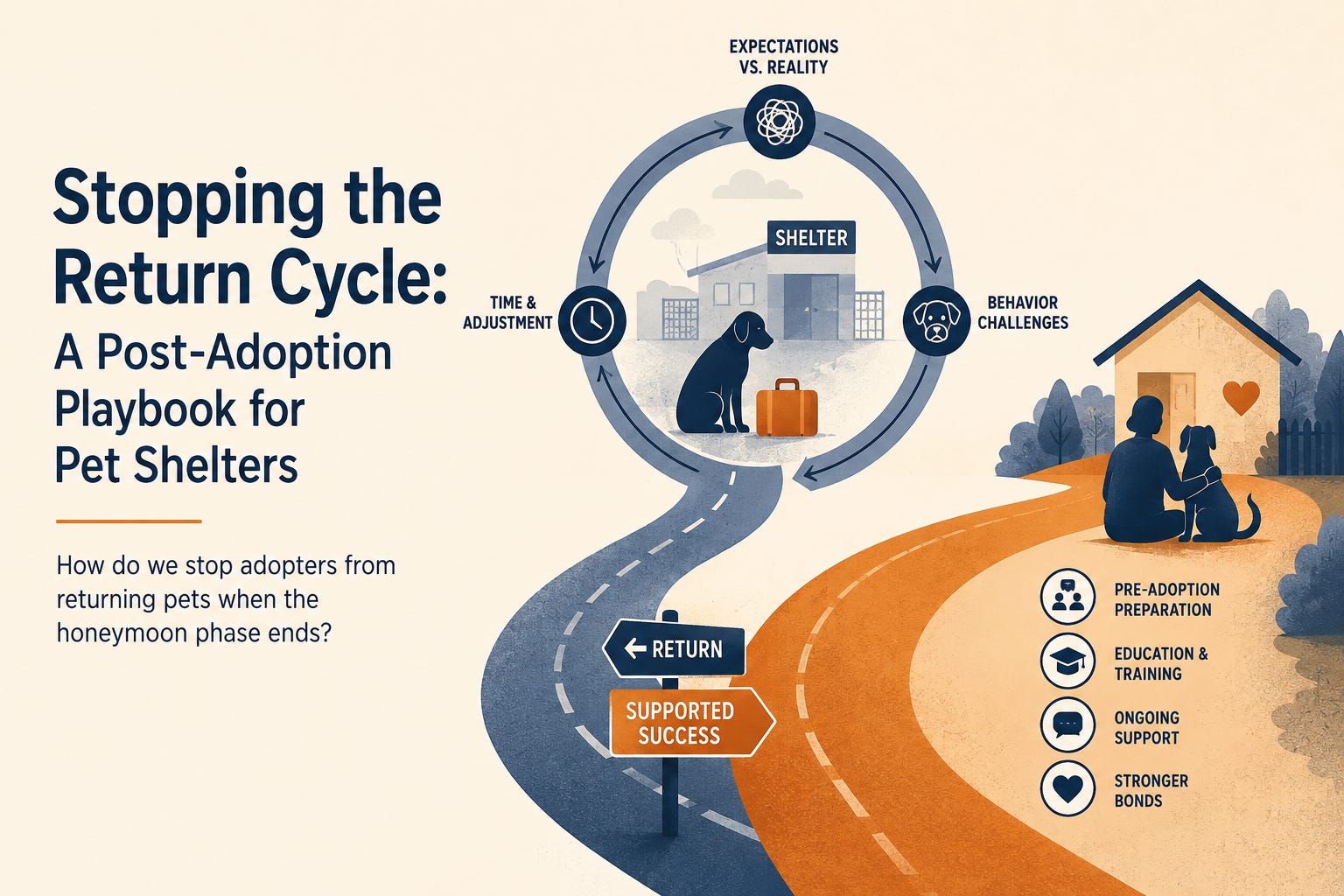
Animal shelters face return rates up to fifteen percent due to predictable behavioral adjustments during early home transitions. Learn how implementing proactive support loops, three-three-three decompression benchmarks, and rapid behavioral triage keeps pets in homes and builds lifelong community trust.
Quick answer
Shelters reduce post-adoption return rates by replacing passive exit processes with proactive, scheduled support loops during critical adjustment windows—specifically at three days, fourteen days, thirty days, and ninety days. Educating adopters on decompression timelines and triaging minor behavior issues early prevents predictable adjustment stress from turning into permanent surrenders.
Why it matters
Up to fifteen percent of adopted pets are returned within the first six months, consuming shelter capacity and causing unnecessary animal stress. Intervening during early behavioral friction costs a fraction of re-intake operations, increases long-term retention, and builds lifelong community trust.
In this breakdown
The reality check: Why traditional front-desk farewells fail adopters during predictable animal decompression phases.
The utility framework: The three-three-three post-adoption support model designed to catch behavior friction before surrenders happen.
The tactical output: Automated communication schedules, behavior triage templates, and front-desk expectation scripts.
Reality Check
Most pet returns do not happen because adopters lack love or commitment. They happen because adopters encounter predictable behavioral shifts without a safety net or realistic expectations.
The honeymoon phase usually breaks down between day seven and day fourteen. As shelter stress wears off, an animal’s true personality emerges along with normal behaviors like mouthing, vocalization, house-training slip-ups, or separation anxiety. When unprepared owners hit these friction points alone, anxiety sets in and surrender feels like the only solution.
Legacy shelter operations treat adoption as a transaction that ends at the front door. Once the leash changes hands, contact drops off until an adopter calls in distress or shows up in the lobby to return the animal.
A proactive post-adoption support loop shifts shelters from reactive intake management to continuous retention support. By establishing scheduled check-ins and clear guidance, organizations resolve minor issues before they become dealbreakers.
The Post-Adoption Retention Playbook
Phase 1: Expectation Calibration at Point of Sale
What to do
Reframe the adoption counseling process around the 3-3-3 Rule, establishing clear benchmarks for decompression, routine adaptation, and full integration.
Why it matters
When adopters know that stress behaviors are normal during early adaptation, they react with patience rather than panic.
How to do it
Provide a single-page visual guide detailing what to expect across three distinct phases:
First 3 Days: Decompression phase (feeling overwhelmed, hiding, or temporary loss of appetite).
First 3 Weeks: Routine adaptation (learning house rules, testing boundaries, showing true energy levels).
First 3 Months: Complete integration (building trust, feeling secure, settling into social dynamics).
Require counselors to review common transitional behaviors (vocalization, panting, minor accidents) during contract signing.
Have adopters complete a brief, three-question commitment checklist confirming they have prepared a quiet decompression space at home.
Real-world example
Shelters using standardized decompression handouts report a noticeable drop in first-week panic calls regarding basic adjustment behaviors like temporary loss of appetite or initial shyness.
Done / not-done criteria
Done: Adopter receives the visual 3-3-3 guide and verbally acknowledges normal decompression behaviors before leaving.
Not Done: Handing the adopter a stack of generic medical forms without discussing behavioral expectations.
Phase 2: Automated Multi-Channel Check-In Loops
What to do
Deploy brief, automated text messages or emails at specific post-adoption milestones to screen for friction points.
Why it matters
Adopters rarely call for help early due to shame or embarrassment. Proactive micro-surveys give them an easy, low-friction way to ask for guidance before reaching a breaking point.
How to do it
Set up automated outreach triggers based on adoption dates using your shelter management software or SMS platform:
Day 3 (Decompression Check): Ask a single scale question: “How is [Pet Name]’s stress level settling on a scale of 1 to 5?”
Day 14 (Routine & Behavior Check): Ask a targeted screening question: “Have you noticed any new habits like barking, chewing, or potty slips? Reply YES or NO.”
Day 30 (Integration Check): Send an encouraging message offering advanced training tips or local group class discounts.
Day 90 (Milestone Celebration): Celebrate three months together and request a photo update.
Adoption Day → Day 3 (SMS Check) → Day 14 (SMS Check) → Day 30 (Email) → Day 90 (Celebration)
If Score < 3 or adopter replies “YES”
↓
Behavior Triage Queue
Real-world example
Shelters leveraging automated text platforms flag low numerical ratings automatically, placing those adopters into a priority follow-up queue for volunteer callbacks.
Done / not-done criteria
Done: Automated SMS triggers fire reliably without manual staff intervention, routing low-score replies directly to a support queue.
Not Done: Relying on staff memory to make manual follow-up phone calls during busy shelter hours.
Phase 3: The Rapid Intervention Triage System
What to do
Establish a simple three-tier protocol to categorize and respond to incoming adopter requests within twenty-four hours.
Why it matters
Speed is the primary factor in saving a placement. An adopter reaching out about separation anxiety who waits four days for a response is far more likely to return the pet than one who gets advice within twelve hours.
How to do it
Train a dedicated volunteer or staff team to route issues based on risk:
Green — Low Risk
Triggers: Crate whining, minor house-training accidents, initial shyness, or other normal adjustment behaviors.
Response time: Within 48 hours
Action: Send relevant digital guides and video tutorials.
Yellow — Moderate Risk
Triggers: Leash reactivity, moderate destructive behavior, separation distress, or guarding human food.
Response time: Within 24 hours
Action: Schedule a 15-minute phone consultation with a behavior team member.
Red — High Risk
Triggers: Bite history, aggression toward family members, severe separation panic, or an immediate threat to human safety.
Response time: Within 4 hours
Action: Begin an emergency virtual assessment or schedule an in-person behavioral evaluation.
Real-world example
Leading rescue groups pair Yellow Tier adopters with experienced volunteer behavior mentors who provide tailored advice and accountability over two weeks.
Done / not-done criteria
Done: 100% of Yellow and Red flags receive a direct callback within their target response windows.
Not Done: Lumping all adopter inquiries into a general email inbox without clear response deadlines or severity tiers.
Ready to move from strategy to execution?
Unlock the full operational toolkit below, including automated SMS scripts, front-desk counseling dialogues, and our downloadable staff triage workflow.
