
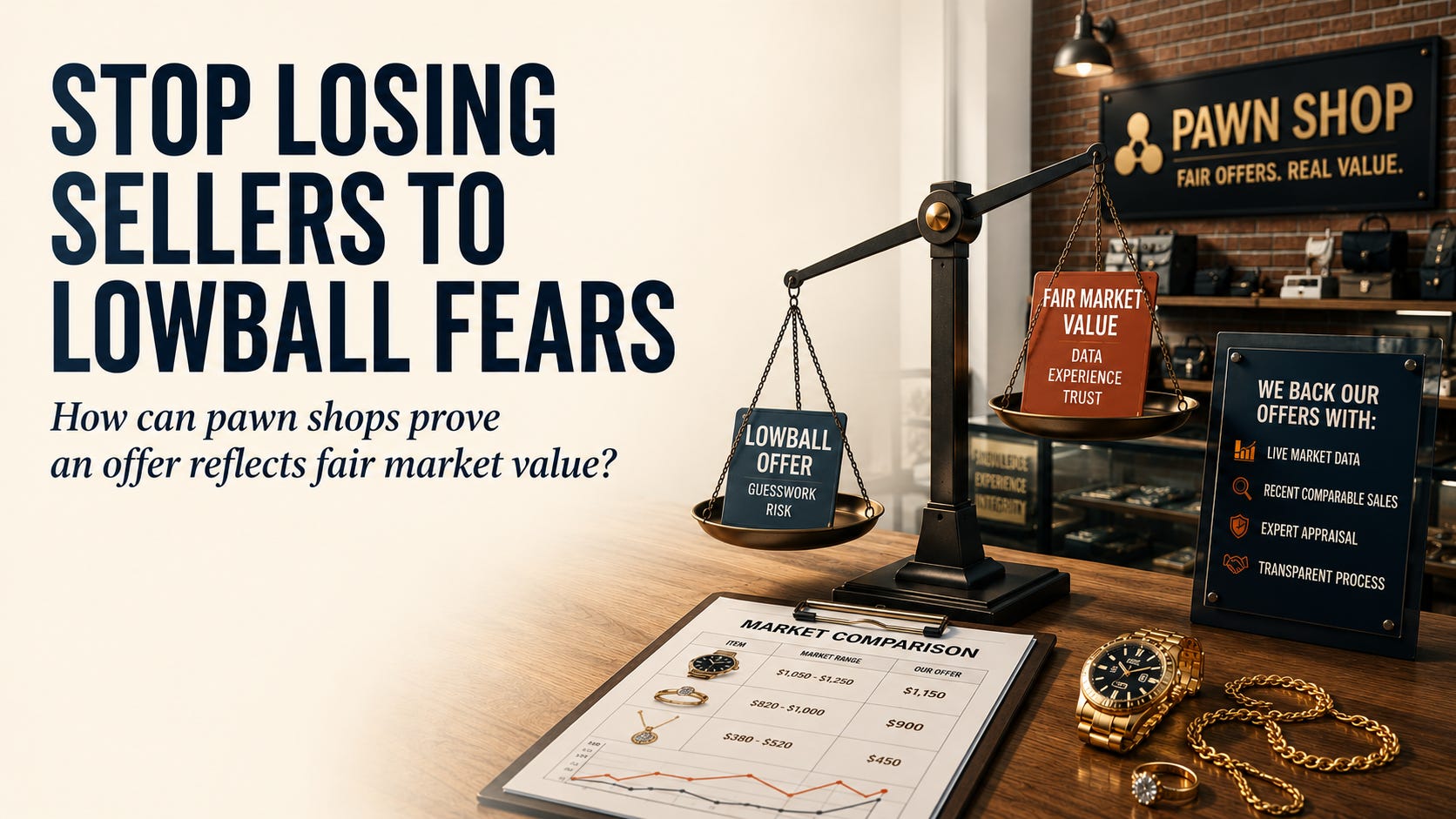
Quick Answer: Use a transparent valuation screen to show sellers exactly how their item’s offer is calculated based on condition, comparable sales, resale costs, and demand. Clear proof turns “lowball” suspicion into trust and repeat business.
The “lowball” reputation is one of the biggest trust barriers pawn shops face. Here is how transparent valuation screens, clear offer explanations, and better staff conversations help skeptical sellers understand the difference between retail price, resale value, and a fair cash offer.
A seller does not walk into a pawn shop asking only, “What will you give me?”
They are also asking:
“Are you trying to take advantage of me?”
That is the real transaction.
The problem is not always the offer itself. It is the gap between what a seller believes an item is worth and what a pawn shop can responsibly pay for it.
A customer may have paid $1,200 for a laptop, seen similar listings online for $700, and expected a cash offer close to that amount.
But a pawn shop has to consider the item’s condition, included accessories, testing time, local demand, resale costs, time on the shelf, and the risk that the item may not sell quickly.
That gap creates the “lowball” stigma.
Fair Does Not Mean Retail Price
A pawn shop’s cash offer is not the same as:
The original retail price
An online asking price
A private-party sale price
The price the shop may eventually resell the item for
A cash offer must account for testing, authentication, cleaning, repairs, storage, security, employee time, payment fees, and inventory risk.
The goal is not to make every seller accept an offer.
The goal is to make sure every seller understands how the offer was reached.
Use a Transparent Valuation Screen
Instead of quietly typing numbers into a computer and saying, “I can do $150,” turn the screen toward the customer.
Show them how the item is being evaluated in real time.
Your valuation screen should answer five simple questions:
1. What is the item?
Show the brand, model, storage size, serial number, accessories, and tested condition.
2. What are similar items selling for?
Use recent sales data when possible, not just high listing prices that may never sell.
3. What affects the item’s value?
Make every condition factor visible:
Missing charger
Cosmetic damage
Battery health
Repair needs
Missing accessories
Account locks
Incomplete sets
Lack of original packaging
4. What is the likely resale range?
Give the customer a realistic range instead of pretending there is one guaranteed resale price.
5. How did that become today’s cash offer?
Explain that the offer reflects resale costs, time to sell, and the business risk of carrying inventory.
This does not need to feel complicated.
It should feel clear, respectful, and easy to follow.
The Staff Script That Builds Trust
Use this simple script:
“Before I give you a number, I want to show you how we evaluate it. We look at the exact model, its condition, what is included, and what similar items are actually selling for right now.”
If the customer mentions the original retail price:
“The original price tells us what it cost new. Today, we price it based on its current condition and what buyers are paying for this version now.”
If they show you a high online listing:
“That is an asking price, which is useful context. We also look at recent sales because they show what buyers actually paid.”
If they say the offer is too low:
“I understand. Here are the specific factors affecting the value: condition, missing accessories, and the current resale range. If you bring the charger, original box, receipt, or other accessories, that may improve the evaluation.”
The goal is not to win an argument.
The goal is to make the offer understandable.
Turn Objections Into Solutions
Transparency gives customers more than a number.
It gives them a path to a better offer.
For example:
A customer can return with a missing charger or power cable.
A seller can bring the original box, receipt, certificate, or appraisal.
A jewelry customer can understand how weight, purity, and verified stones affect value.
A gamer can bring controllers, cables, and games to create a more valuable bundle.
A phone seller can remove account locks before returning.
Even when a seller declines, they are less likely to leave believing they were treated unfairly.
They may compare offers and return later.
That is how a skeptical walk-in becomes a repeat customer.
Upgrade to paid to unlock the valuation-screen template, customer scripts, category playbooks, staff-training plan, and 30-day rollout guide.
