
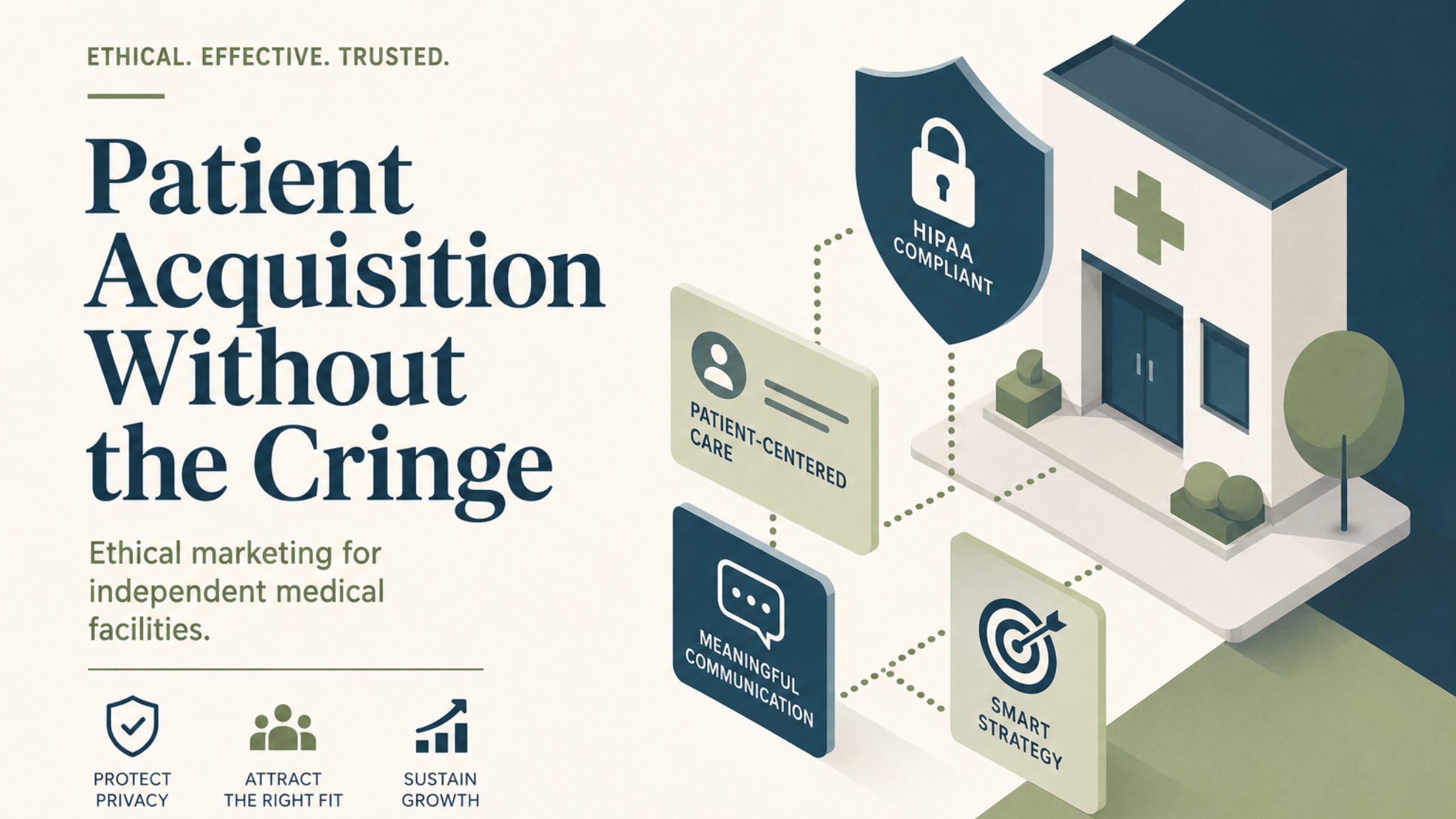
Growing a private practice shouldn't mean relying on flashy advertising tactics that compromise your clinical authority or risk costly compliance fines. This guide breaks down how to build a high-converting, HIPAA-compliant patient acquisition engine using educational content and local search optimization. You’ll see how to turn your medical expertise into your most powerful growth tool while keeping patient trust completely intact.
The bottom line
Independent medical facilities can attract high-quality patients by combining educational content, strong local SEO, and clear HIPAA-aware processes that never use protected health information (PHI) for marketing without proper authorization. When you treat your clinical expertise as the product and your content as the front door, you grow demand while protecting your reputation and compliance.
Why ethical, HIPAA-safe marketing matters now
Most independent medical facilities still rely on word-of-mouth, a dated website, and occasional social posts, while patients increasingly start their journey on Google, local maps, and high-trust review platforms. At the same time, the HIPAA Privacy Rule puts strict limits on using and disclosing PHI for marketing and requires written authorization for most marketing communications that involve identifiable patient information.
That combination creates a real tension: you need predictable growth, but you can’t just copy generic growth tactics from other industries. Tactics like retargeting based on medical conditions, broad email blasts without clear consent, or sharing lists with third-party advertisers might work elsewhere, but they can be non-compliant, reputation-damaging, or both in healthcare.
The solution is to design your patient acquisition system specifically for a healthcare environment: treat HIPAA as a set of design guardrails, use education instead of hype, and structure your local presence so the right patients can actually find you.
Step 1: Set your ethical and compliance boundaries
Before you touch tactics, define your red lines.
No use of PHI in marketing communications without explicit, written authorization.
No retargeting or audience building based on specific medical conditions or diagnoses.
No incentives or offers that could reasonably be seen as patient inducement.
This isn’t just legal protection; it’s also branding. When you are clear that your practice will not use patient data to chase clicks, you are signaling to patients that you put privacy and dignity first. Turn this into a simple one-page policy you review with your staff and any agency or freelancer who touches your marketing.
Step 2: Turn your clinical expertise into an educational content engine
Instead of flashy ads, your primary marketing asset is your expertise.
Build an editorial calendar around:
Common consult questions.
Condition explainers.
Treatment option comparisons.
Pre-visit guides.
Keep everything patient-friendly and anonymous: no identifiable stories, no screenshots of charts, and no casual references that could expose patient information. Anchor each piece of content to a specific service your facility offers and make the content useful enough that the right patient sees your authority before they ever contact you.
With this approach, your content does three jobs: it educates, filters for fit, and creates demand without undermining trust.
Step 3: Build a HIPAA-aware local SEO foundation
Educational content only works if people can find it.
Make sure your basics are in place:
Your name, address, and phone (NAP) are consistent across your website, Google Business Profile, and major directories.
Your Google Business Profile is fully set up with accurate categories, hours, photos of the facility, and a clear description of services.
Your website has service-area pages instead of just a generic services page.
You have claimed and cleaned up listings on healthcare-specific directories where appropriate.
When patients search for care in their area, you want to show up with a page that answers their question and a profile that looks trustworthy. Any intake form, online booking widget, or chat tool that collects PHI needs to be HIPAA-compliant.
Step 4: Design compliant communication and follow-up workflows
Many problems happen after the click, not on the website.
Separate your communications into two buckets:
Operational and treatment messaging: appointment reminders, test result notifications, pre-procedure instructions, post-visit follow-ups.
Marketing and relationship-building: newsletters, service announcements, educational campaigns, and reactivation emails.
For the operational bucket, focus on security and clarity. For the marketing bucket, use clear consent and careful content. Patients should understand what they are signing up for, and you should only send what matches that expectation.
Use tools and vendors that are explicitly designed for healthcare and are willing to sign the right agreements when PHI is involved. Document your consent logic and make sure your team can explain it clearly if a patient asks.
Step 5: Measure trust, fit, and outcomes—not just volume
Ethical marketing is not just about avoiding violations; it is about who you attract.
Look beyond how many new patients came in to metrics like:
How many of those patients were the right clinical fit?
Did they show up for appointments and follow treatment plans?
How satisfied are they with communication, clarity, and experience?
Are they referring others who look like your ideal patients?
Combine basic analytics with periodic reviews of patient mix and experience. If you notice spikes in inquiries that are clinically misaligned or clearly driven by a gimmick, that is a sign your message is off.
Your goal is a patient panel that you and your clinicians actually want: the right conditions, the right expectations, and a shared focus on long-term health rather than quick fixes.
Bringing it together
If you treat HIPAA as a design constraint rather than a roadblock, you can build a patient acquisition system that feels like an extension of your clinical ethics. Educational content becomes the way you show up in patients’ searches, local SEO becomes the bridge between questions and appointments, and your communication workflows protect privacy while supporting long-term trust.
The result is not flashy advertising. It is a quiet, steady engine that helps your independent medical facility attract the right patients without shortcuts and without compromising the reputation you have worked hard to build.
If this framework is helpful and you want the templates and checklists to implement it in your practice, you can upgrade to the premium version of this newsletter to get the full playbook.
PAYWALL BREAK
Below the paywall, the premium section includes the templates, scripts, and checklists needed to put this into practice. If you are ready to implement it, upgrade to the premium version of this newsletter to get the full playbook.
