
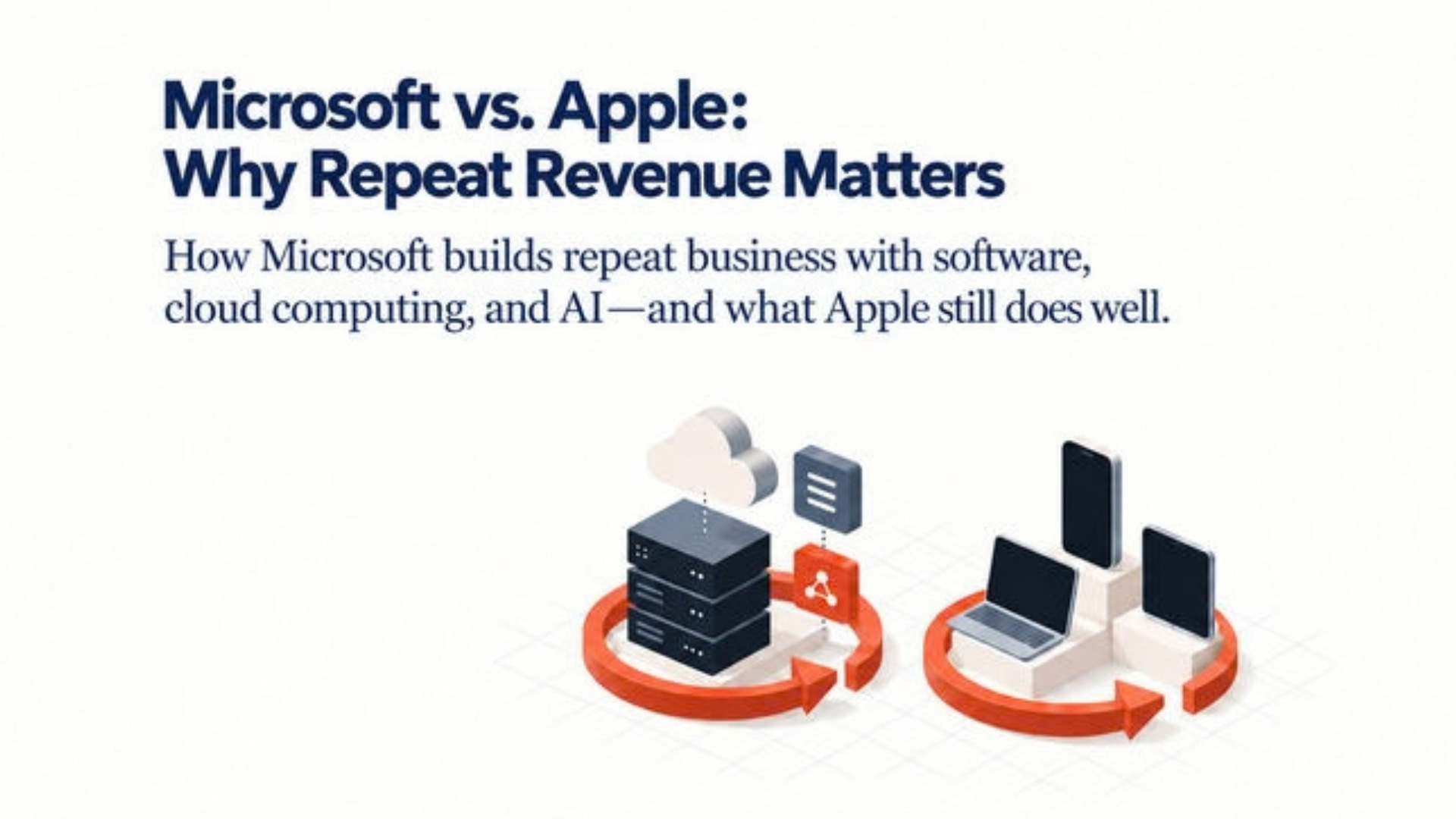
Description: Microsoft can earn from the same customer through software access, cloud usage, and added AI tools. We explain how that model works, why Apple’s services matter, and how to check whether a recurring offer would pay off in your own business.
Quick Answer
Microsoft builds repeat revenue by charging for business software, cloud computing, and paid AI tools inside customers’ existing systems. Spending can rise as customers add staff, use more computing power, or buy extra features. Apple also earns money from services, but devices still supply most of its sales. The business lesson is to solve a problem customers keep having.
The June results: faster cloud growth, larger Apple sales
Microsoft’s cloud sales grew faster than Apple’s total revenue in the June 2026 quarter, while Apple brought in more total sales.
Here is the comparison for the whole companies:
Microsoft
Quarter ended: June 30, 2026.
Total revenue: $90.0 billion.
Growth from a year earlier: 18%.
Apple
Quarter ended: June 27, 2026.
Total revenue: $109.4 billion.
Growth from a year earlier: 16%.
The figures come from Microsoft’s July 29 earnings release and Apple’s July 30 earnings release. The quarters cover much the same period. The growth rates use reported U.S. dollar figures.
Within Microsoft, Cloud revenue rose 27%, and Azure and other cloud services grew 43%. These are overlapping measures of different parts of Microsoft’s business.
Microsoft’s cloud revenue was growing quickly. The gap between the companies’ overall growth rates was much smaller, and the figures do not tell us how much growth came from AI alone.
Microsoft has several ways to earn the next sale
Microsoft can earn more from an existing business customer as that customer adds users, runs more software in the cloud, or buys extra services.
Picture a distributor that uses Microsoft software for email, files, and orders. Hiring staff may require more licenses. Processing more orders may increase the computing power it uses. Adding a paid AI tool creates another possible sale.
Microsoft’s Azure purchasing guidance explains usage billing and longer-term commitments. Usage can also fall, so a monthly bill does not guarantee a fixed income.
The likely advantage is that Microsoft becomes part of how the business runs. Replacing it can mean moving files, rebuilding connections, and retraining staff. Those are switching costs: the time, money, and disruption involved in changing providers. They can give a customer a reason to stay, alongside the service’s value.
AI can reach a customer through software they already use
Microsoft can sell AI through relationships and work systems it already has in place.
It reported more than 30 million paid Microsoft 365 Copilot seats, or user licenses, in its July earnings call. That shows paid demand. The customer’s reason to renew still depends on what the tool does for them.
Microsoft’s Copilot documentation explains how existing Microsoft 365 access controls apply. That connection offers a possible sales advantage: the new tool can work with systems already in use. The permissions still need to be set correctly.
Apple’s services belong in the comparison
Apple depends heavily on device sales, and its services business gives it another way to earn from customers.
Its June-quarter filing reports $30.7 billion in Services revenue, up 12%, with a 75.6% gross margin. Gross margin is what remains after cost of sales, before operating expenses.
Products supplied about 72% of Apple’s total sales, calculated from that filing. Device purchases therefore remain central. Services adds income between those purchases, although the category includes more than subscriptions.
Repeat revenue still comes with large costs
Microsoft has to spend heavily to build and run the infrastructure behind its cloud services.
In the same earnings call, it reported $41 billion in quarterly capital expenditures, including finance leases. Cash paid for property and equipment was $35.8 billion. Microsoft Cloud’s gross margin was 65%, down from a year earlier.
Servers, buildings, and power cost money. An AI sale also creates work and computing costs that must be covered.
Give customers a reason to pay you again
A recurring offer works when the customer has a recurring problem and receives a result worth paying for again.
That could mean maintenance after an installation or monthly support after a project. The continuing payment should cover something the customer continues to need.
For related reading, see The Invisible Price Tag: Prestige Before Cost on pricing, and The Death of the Follower Count on turning attention into revenue.
Subscribe to Tips on Business, and comment with a customer problem you solve repeatedly.
The paid section includes a pricing worksheet, a worked cost example, a customer-renewal check, and a seven-day checklist for setting up a small trial.
