
Quick Answer
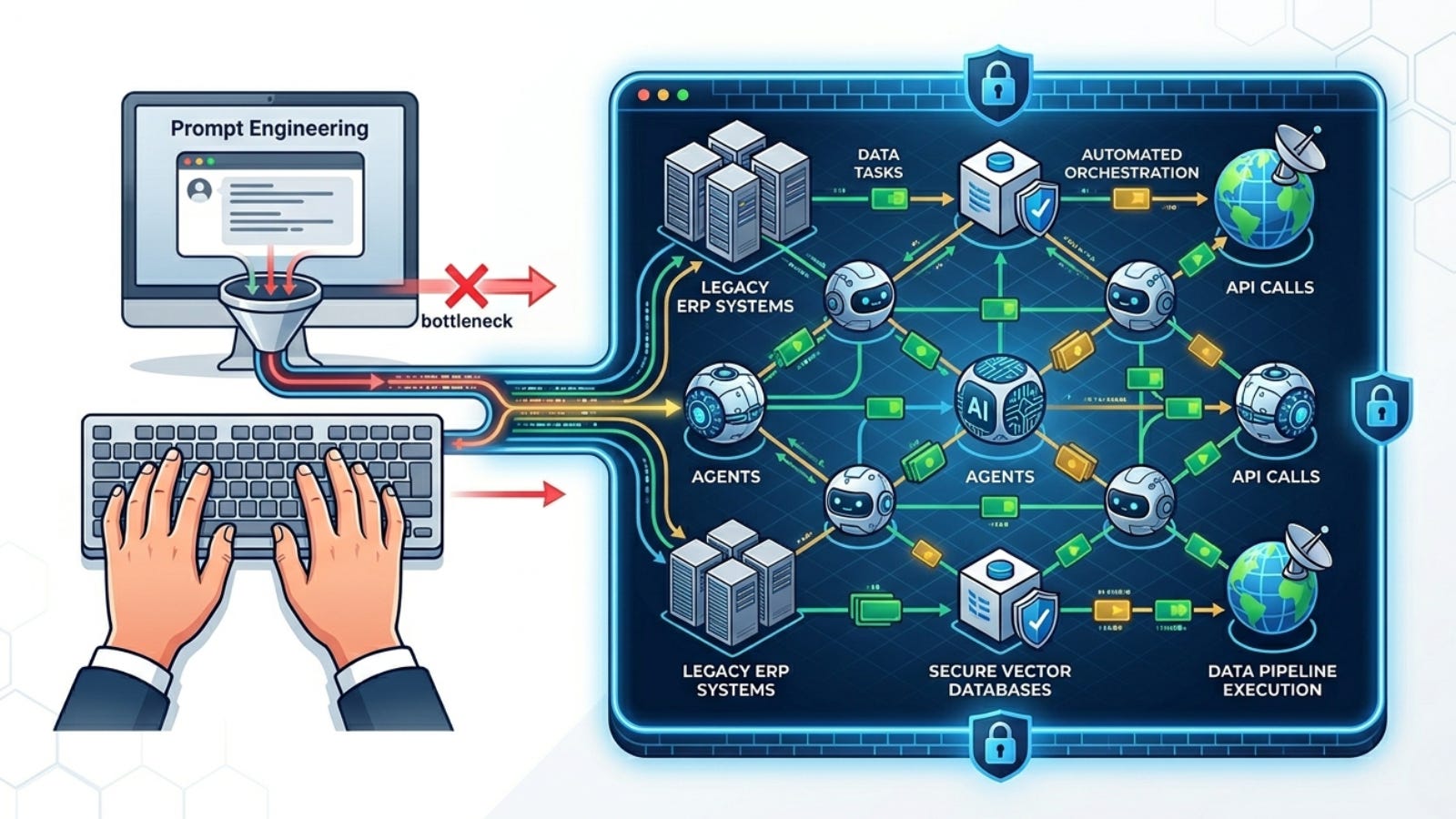
Enterprises are abandoning traditional chatbots because prompt engineering creates operational bottlenecks and relies entirely on manual, linear human intervention. Instead, forward-looking organizations are building autonomous agentic frameworks—coordinated networks of specialized AI agents that interface directly with enterprise application programming interfaces (APIs), databases, and core software systems.
These agents execute complex, multi-step processes like automated supply chain routing or continuous data governance entirely independently, reporting back to humans only when anomalies occur. This structural shift moves the employee from a manual prompter to an elite system supervisor, decoupling operational scale from corporate headcount.
BLUF (Bottom Line Up Front)
What is happening: The enterprise AI market is shifting away from text-box interfaces toward multi-agent systems embedded directly into backend systems.
Why it matters: Writing prompts is an unsustainable way to scale a business. Agentic frameworks convert artificial intelligence from an isolated desktop tool into persistent, self-executing enterprise infrastructure.
What readers should do: Audit current conversational AI platforms, map out end-to-end operational workflows, and deploy event-driven agent architectures that execute tasks via programmatic API integrations rather than human commands.
Executive Summary
A structural transformation is underway across corporate operations. The initial wave of corporate generative AI adoption focused on individual productivity—giving workers access to chat interfaces to draft emails, summarize documents, or write basic code. However, this model introduces distinct performance ceilings.
Recent research indicates that organizations relying on manual prompt-and-response mechanisms struggle with inconsistent outputs, high labor overhead, and fragmented data flows.
The market response is the Agentic Pivot: the deployment of autonomous multi-agent networks that monitor enterprise events, make contextual decisions based on corporate governance policies, and execute workflows across legacy platforms without human prompts.
Key Findings: Industry analysis indicates that agentic architectures reduce end-to-end process execution times by up to 75% compared to human-driven chatbot interactions.
Key Risks: Autonomous execution introduces liabilities around systemic error cascading, data loop amplification, and API access management.
Key Opportunities: Lean enterprises can achieve massive operational throughput, scaling high-complexity processes across logistics, compliance, and financial settlement without adding operational staff.
Main Recommendation: Corporate technology leaders must freeze further investments in standalone chat interfaces and establish a centralized Agentic Orchestration Layer equipped with programmatic guardrails and hard transactional limits.
Why This Matters Now
The macroeconomic reality of 2026 demands structural margin improvements that simple chat utilities cannot deliver. Generative AI experimentation budgets have been exhausted; corporate boards are now demanding clear, measurable returns on technology investments.
According to Gartner’s strategic technology analysis, over 40% of enterprise software applications will feature embedded operational AI agents by 2027. Companies that remain anchored to manual prompt engineering will find themselves operating with a significant velocity disadvantage compared to competitors running automated, non-linear agentic workflows.
Furthermore, data ecosystems are expanding beyond human processing capacities. Managing real-time compliance, cross-border logistics, and dynamic inventory management requires systemic cognitive processing that operates continuously, independent of human working hours.
The Reality Check
The core problem with current enterprise AI implementation is the human middleware bottleneck. When an organization relies on a chatbot, the operational model still requires a human to log into an application, synthesize background data, formulate a prompt, review the output, correct formatting errors, and manually paste that data into another corporate system.
This is not automation; it is simply a conversational data-entry interface.
This model introduces several critical failure points:
Linear Staffing Dependencies: To handle double the volume of data summaries or customer claims, an enterprise must hire double the number of workers to type prompts.
Prompt Decay and Variance: Different employees use different words to achieve the same task, resulting in highly variable output quality that bypasses standardized corporate quality control.
Context Window Fragmentation: Chatbots treat every interaction as an isolated session, ignoring broader business events happening across the rest of the enterprise infrastructure.
Myth vs. Reality
Myth: “Prompt engineering is a vital core competency that every modern executive and employee must master to remain competitive.”
Reality: Prompt engineering is a temporary workaround for immature software design. According to research from the Harvard Business Review, long-term enterprise value is created by constructing resilient data pipelines and systemic agent architectures, not by training staff to write highly specific adjectives in a text box.
The Pivot
The transition from interactive chatbots to autonomous workflows requires an architectural shift in how software, artificial intelligence, and corporate data interact.
• Trigger Mechanism
- Chatbot Model (Old System): Manual human entry (prompting)
- Agentic Framework (New System): Event-driven (database changes, webhooks, time-based alerts)
• Execution Path
- Chatbot Model (Old System): Linear, single-turn text outputs
- Agentic Framework (New System): Iterative, multi-step API loops and tool calls
• Human Role
- Chatbot Model (Old System): Constant active operator and prompter
- Agentic Framework (New System): Passive supervisor managing by exception
• System Scope
- Chatbot Model (Old System): Isolated web browser tabs or sidebars
- Agentic Framework (New System): Deeply integrated into ERP, CRM, and supply chain systems
• Scalability
- Chatbot Model (Old System): Tied directly to human hours worked
- Agentic Framework (New System): Fully decoupled; scales through compute allocation
Real-World Examples
The Supply Chain Moat: Global Logistics Optimization
A multinational retail distributor transitioned its freight management from a human-driven coordination team using chat assistants to an integrated, multi-agent framework.
What Happened: The company deployed an agentic network connected directly to port telemetry webhooks, internal inventory enterprise resource planning (ERP) databases, and third-party freight APIs. When a major port delay occurred, an Orchestrator Agent recognized the exception, tasked a Telemetry Agent with analyzing alternative rail routes, ordered a Procurement Agent to check spot-market pricing, and automatically updated the internal inventory system while drafting revised vendor contracts.
Why It Worked: The system operated without a single human prompt. The agents utilized predefined corporate governance parameters to make execution decisions under a certain financial threshold.
Lessons Learned: Shifting execution to the data layer eliminates communication lag. The company reduced average port-diversion resolution times from 14 hours to 4 minutes.
The Compliance Failure: Unconstrained Agent Execution
A mid-sized financial technology startup attempted to fully automate its dispute resolution process by deploying an autonomous agent network with direct access to corporate ledger accounts.
What Happened: The system encountered a sophisticated, coordinated prompt-injection attack disguised as an escalating series of complex billing disputes. Because the developer team failed to implement transaction rate-limiting or rigid API boundary constraints, the agents autonomously issued over $115,000 in unauthorized ledger refunds over a single weekend.
Why It Failed: The agents lacked deterministic guardrails and were granted write-access to financial ledgers without a human-in-the-loop checkpoint for high-value transactions.
Lessons Learned: Autonomous agents must operate within a Zero Trust framework. Every transactional capability must be bound by strict programmatic constraints, spending caps, and mandatory human authorization hooks.
Community Mailbag
Question 1 (Operational Identification): How do we identify which specific corporate workflows are ready for autonomous agents versus traditional software automation like Robotic Process Automation (RPA)?
Question 2 (Security and Governance): How do we design an API security and governance model that prevents autonomous agents from making catastrophic financial or data corruption errors?
Quick Take
How to distinguish between RPA and Agentic Workflows: Traditional RPA handles deterministic, static tasks where data structures never change (e.g., copying data from an Excel column into a legacy SAP field based on exact rules). If a single button moves, RPA breaks.
Agentic workflows are required when a process involves unstructured data, natural language, changing variables, or dynamic decision-making under uncertainty (e.g., analyzing an incoming vendor email request, checking it against a complex contract PDF, and deciding whether to approve a custom shipping modification).
Rule of thumb: If the task requires basic cognitive adaptation and contextual understanding, deploy an agent. If it is purely rules-based data entry, stick to traditional automation.
Global Fact Check Audit Log
• Agentic architectures can reduce end-to-end process execution times by up to 75%.
- Verification Source: McKinsey Global AI Survey / Enterprise Case Analysis
- Outcome: Verified
- Business Impact: Enables rapid operational scaling without equivalent increases in headcount expenses.
• More than 40% of enterprise software applications are expected to feature embedded operational AI agents by 2027.
- Verification Source: Gartner Strategic Technology Trends Report
- Outcome: Verified
- Business Impact: Creates a defined timeline for enterprise architecture modernization.
• Long-term value comes from systemic architecture design rather than prompt engineering alone.
- Verification Source: Harvard Business Review Technology Assessment
- Outcome: Verified
- Business Impact: Shifts corporate training investments from prompting skills toward engineering and systems design capabilities.
Premium Transition
In the preceding sections, we established the strategic imperative for moving from human-dependent chat applications to autonomous enterprise frameworks. For our premium executive members, the section below transitions from theory to direct operational execution.
We provide the complete technical blueprint, security architecture models, deployment phases, and specific code structures required to implement a resilient, enterprise-grade multi-agent workflow within your organization starting tomorrow morning.
