
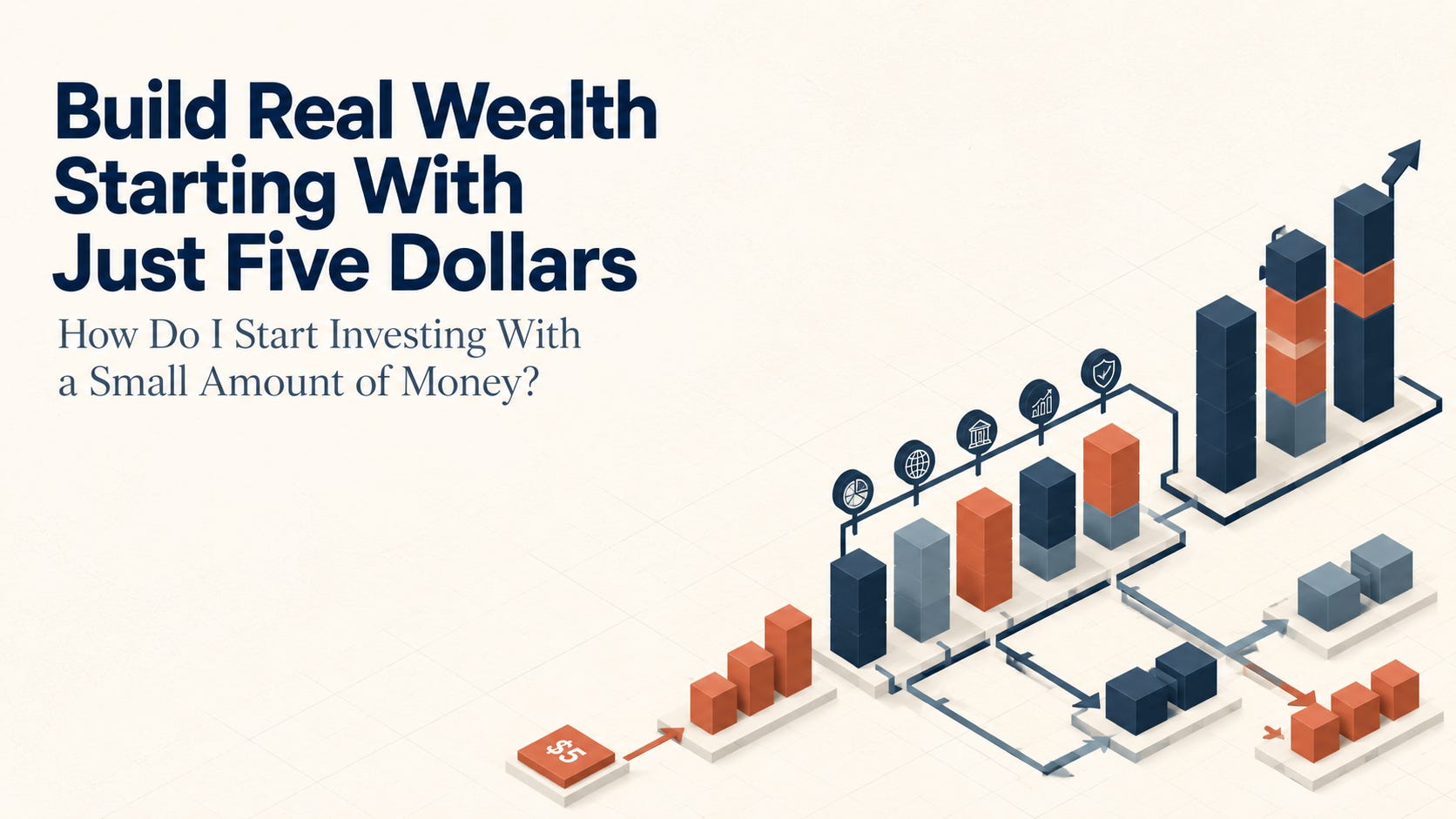
You don’t need thousands of dollars to begin investing. Fractional shares, low-cost index funds, and automatic deposits can put even $5 to work. The amount gets you started, but lasting wealth comes from contributing regularly, keeping costs low, spreading risk across many investments, and giving your money time to grow.
This article is for educational purposes and doesn’t provide personalized investment, tax, or legal advice. All investments involve risk, including the possible loss of principal.
Quick Answer
You can start investing with $5 by using a brokerage that offers fractional shares and recurring deposits. Keep emergency and short-term money in savings, then invest long-term money in a diversified, low-cost fund suited to your goals and risk level. The starting amount matters less than contributing consistently, controlling fees, and staying invested.
Yes, You Can Start Investing With $5
Investing means putting money into assets such as stocks or bonds with the expectation of earning a return over time. According to the U.S. Securities and Exchange Commission’s Investor.gov, returns may come from an increase in the asset’s value, interest payments, or dividends.
Fractional-share investing allows you to purchase part of a stock or exchange-traded fund instead of paying for one full share. If an investment trades at $200 per share, for example, a brokerage that supports fractional trading may let you invest $5 and own a small portion of it.
Not every brokerage offers the same fractional investments. Order types, voting rights, dividend handling, and transfer rules can also differ. Review the brokerage’s fractional-share agreement before buying.
The main point is straightforward:
Five dollars is enough to begin investing. It isn’t enough to build substantial wealth unless you continue contributing.
The first $5 establishes the habit. Your future deposits do the heavy lifting.
Build the Financial Foundation First
Before investing your first $5, decide whether you may need that money soon.
Money for rent, groceries, utilities, minimum debt payments, or emergencies generally belongs in a stable and accessible account. Stocks can lose value without warning, and you don’t want to be forced to sell during a market decline because your car needs a repair.
A practical financial order to consider is:
Cover essential expenses.
Make required debt payments.
Begin building an emergency cushion.
Contribute enough to capture an available employer retirement-plan match.
Pay down high-interest debt.
Invest consistently for long-term goals.
This isn’t an inflexible rule. Someone building emergency savings might put $20 into savings and $5 into an investment account each week. The right balance depends on income stability, debt, household responsibilities, and upcoming expenses.
If a credit card charges 25% interest, paying down that balance may improve your financial position more reliably than investing money in hopes of earning a lower, uncertain return.
Consistency Matters More Than the Starting Amount
Your starting balance matters less than the behavior you build around it.
The SEC defines dollar-cost averaging as investing equal amounts at regular intervals regardless of market movements. It doesn’t guarantee a profit or prevent losses, but it reduces the need to guess when prices are about to rise or fall.
Here’s what several small contribution schedules look like before investment gains or losses:
How Weekly Investing Adds Up
Invest $5 Per Week
Average monthly contribution: About $22
Total contributed in one year: $260
Invest $10 Per Week
Average monthly contribution: About $43
Total contributed in one year: $520
Invest $25 Per Week
Average monthly contribution: About $108
Total contributed in one year: $1,300
Invest $50 Per Week
Average monthly contribution: About $217
Total contributed in one year: $2,600
The goal is to choose an amount you can continue investing during an ordinary month. A sustainable $5 weekly deposit is more useful than an ambitious $100 deposit that forces you to stop, overdraw your bank account, or withdraw the investment.
Don’t Treat Investing Like Gambling
A common beginner mistake is putting the entire $5 into whichever stock, cryptocurrency, or online trend looks most exciting.
That isn’t a long-term wealth-building system. It’s a concentrated bet.
A broadly diversified fund can hold shares in dozens, hundreds, or even thousands of companies. If one company performs poorly, it represents only part of the portfolio. Diversification can’t prevent all losses, but it reduces the risk of depending on a single company or investment.
Other common mistakes include:
Trading frequently because an app makes it easy
Buying investments without understanding them
Ignoring fund expenses and account fees
Investing money needed for emergencies
Borrowing to invest through a margin account
Selling whenever the market falls
Expecting a small deposit to produce fast income
Following social-media tips without independent research
Your first $5 should build a repeatable system, not chase a quick payoff.
Upgrade to the paid tier for the complete account-selection guide, investment decision matrix, automation plan, growth examples, and monthly portfolio routine.
