
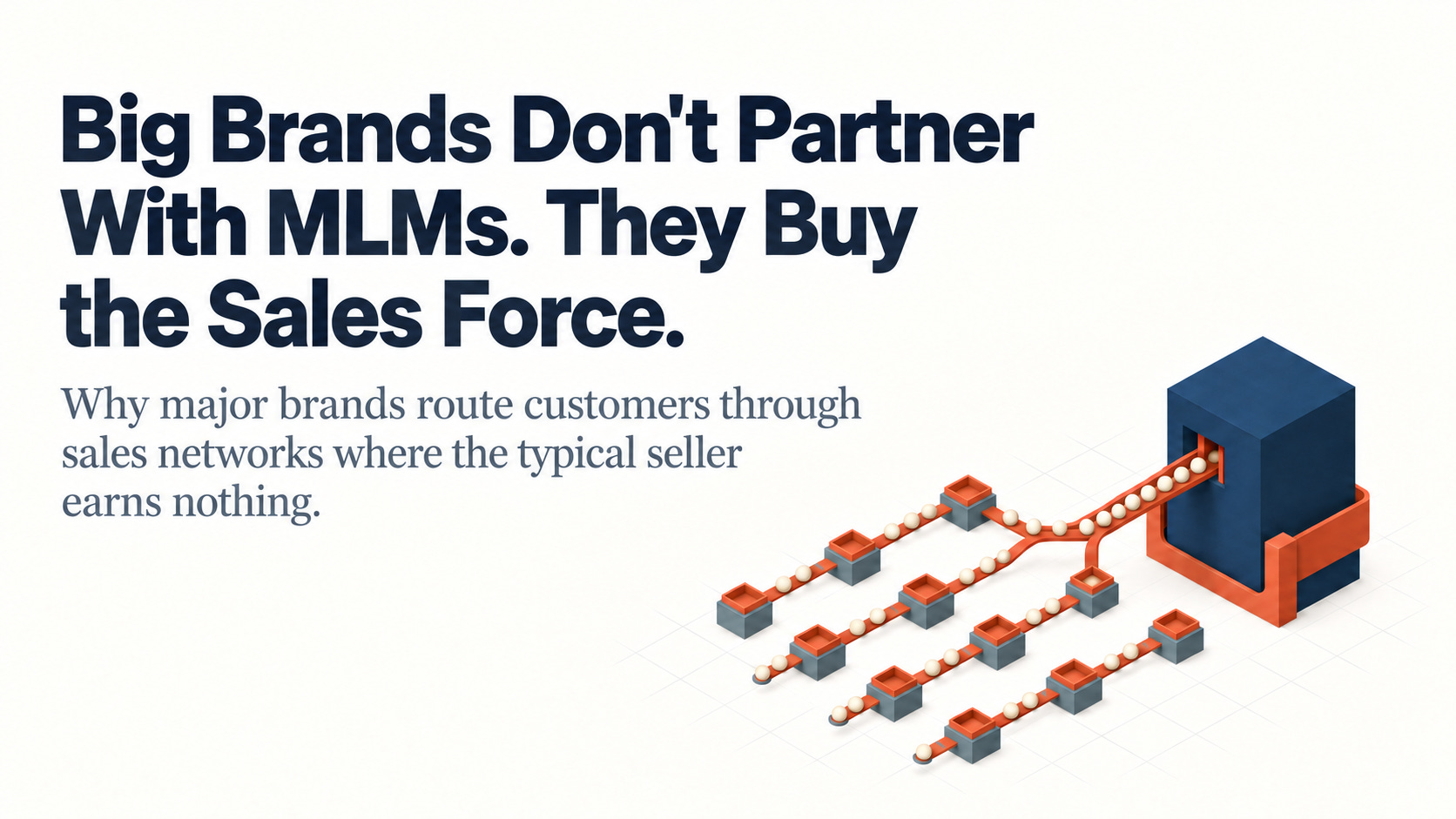
Quick answer: Major brands route customers through direct-sales networks because the arrangement converts every customer-acquisition cost into a payment made only after a sale. No salaries, no advertising, no commission until a bill is generated. Sellers who sign nobody cost the company nothing, so a network in which most people earn nothing still functions exactly as designed.
A direct-selling channel is a distribution arrangement in which a brand acquires customers through a network of independent contractors who are paid only on results, bear their own costs, and recruit their own replacements. What follows is what that channel sells for, who captures the returns inside it, and how to read the disclosure documents that show both.
The current state
The common framing is that a household brand “partners with” a multi-level marketing company, and the interesting question is why a reputable company would associate itself with one. That framing gets the transaction backwards, and it also gets the industry wrong.
In consumer packaged goods, brands mostly do not do this. Herbalife, Nutrilite, Mary Kay, and Tupperware sell their own products under their own labels. There is no outside brand to explain.
Where the phenomenon is real is in services: retail energy, telecommunications, satellite television, home security, and life insurance. In those categories the seller is not moving inventory. They are signing a contract that generates a recurring bill, paid by a genuine customer, to a genuine provider. The provider is not lending its name to a marketing scheme. It is buying a sales channel.
The evidence
In August 2019, Vistra Energy announced an all-cash agreement to acquire Ambit Energy for $475 million plus net working capital. Ambit was then the largest energy-focused direct seller in the United States, serving roughly 1.1 million residential customer equivalents across 17 states.
Vistra’s press release did not bury the rationale. Its bullet points name Ambit’s direct-selling capability, its proprietary technology platform, and its network of consultants as the assets being acquired. Vistra’s CEO described Ambit as a match for Vistra’s retail business specifically on the strength of that direct-selling capability. The channel was the acquisition.
Run the arithmetic on what it cost:
Purchase Price
Figure: $475 million
Residential Customer Equivalents Acquired
Figure: Approximately 1.1 million
This figure represents residential customer equivalents, which may not equal the number of individual customer accounts.
Implied Cost per Customer Equivalent
Figure: Approximately $432
Calculation: $475 million ÷ 1.1 million customer equivalents = approximately $432 per customer equivalent.
Expected Annual Adjusted EBITDA After Synergies
Figure: Approximately $125 million
This estimate includes expected post-acquisition synergies and is not necessarily the acquired business’s standalone EBITDA.
Implied Adjusted EBITDA Multiple
Figure: Approximately 3.8×
Calculation: $475 million purchase price ÷ $125 million expected annual adjusted EBITDA = 3.8×.
Vistra bought roughly a million recurring residential energy accounts, plus the machine that produced them, at under four times expected EBITDA. For a business with high customer acquisition costs and punishing churn, that is a rational purchase at a reasonable price.
The same logic runs through financial services. Aegon, the Dutch insurer that owns Transamerica, describes World Financial Group on its own corporate site as Transamerica’s affiliated distribution network of more than 92,000 independent agents who sell Transamerica products alongside those of other insurers, and calls it a key component of Transamerica’s growth strategy. That is not a disclaimer in a footnote. It is a parent company describing a recruitment-driven agent network as core strategy, in public, to shareholders.
The new way forward
Once you see the transaction as channel acquisition rather than brand partnership, the compensation structure stops being puzzling.
A brand acquiring customers the conventional way pays for advertising, sales salaries, and overhead before a single customer signs. Those are fixed costs incurred in advance of revenue. A direct-selling channel converts every one of them into a variable cost paid in arrears. Nobody gets paid until a bill is generated. Recruitment, training, and territory expansion are pushed onto the network and funded by the network’s own participants.
The channel is cheapest to the brand precisely when the largest number of participants produce nothing. This is not a flaw the industry has failed to fix. It is the property that makes the channel worth buying.
Which raises the question this section can only pose: if the brand is capturing the value, what does the distribution look like from inside the network?
